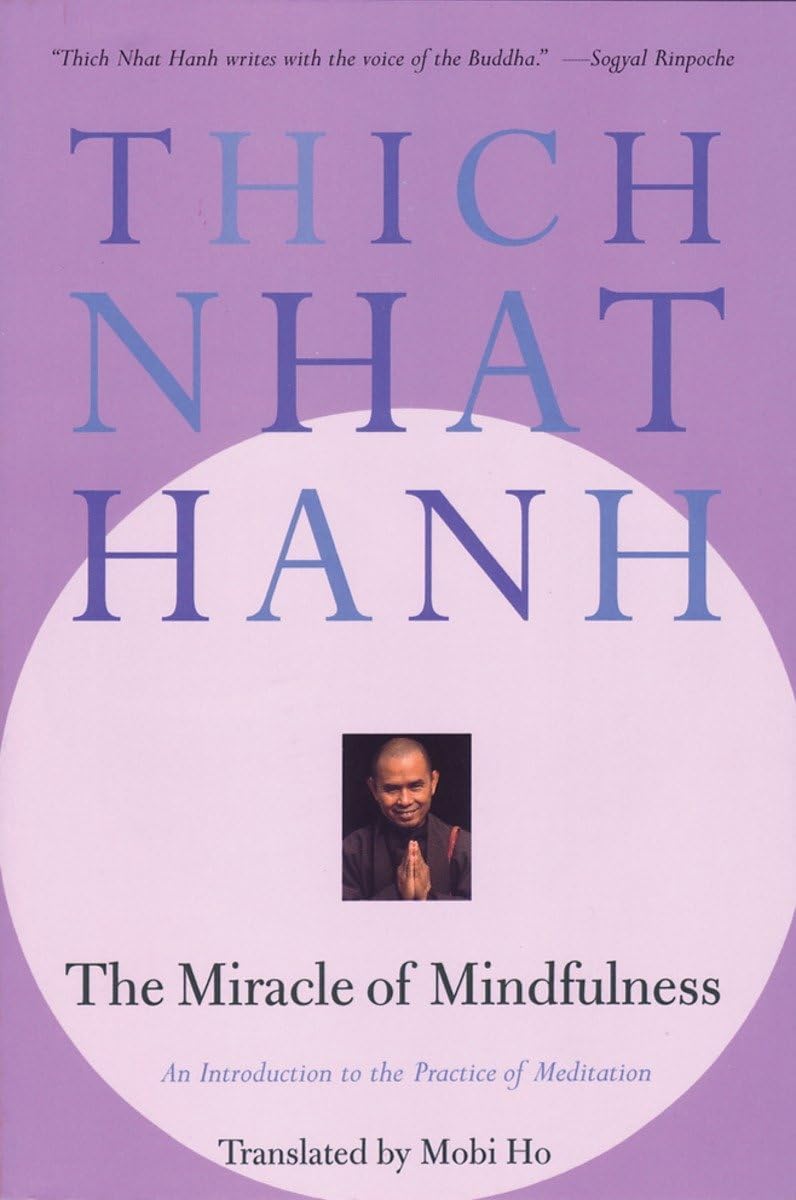
The Miracle of Mindfulness
An Introduction to the Practice of Meditation
By Thich Nhat Hanh · 140 pages
In this small book, Thich Nhat Hanh teaches the essentials of mindfulness through a single question that reframes everything: who is washing the dishes? The answer determines whether you are practicing or merely passing time.
What This Book Is
Thich Nhat Hanh wrote The Miracle of Mindfulness in 1975 as a series of letters to a colleague running a children’s clinic during the Vietnam War. He was writing about how to stay genuinely present under conditions that made presence almost impossible. The book was never meant to be a bestseller. It became one anyway, and nearly fifty years later it remains one of the clearest introductions to mindfulness ever written in English.
What distinguishes it from the hundreds of mindfulness books that followed is its refusal to separate the ordinary from the sacred. Thich Nhat Hanh does not ask the reader to carve out special time for mindfulness and then return to regular life. He asks something more radical: that washing dishes, answering the phone, and drinking tea all become the practice. Not preparation for the practice. The practice itself.
At 140 pages it can be read in an afternoon. Its central insight — that attention brought to any activity transforms that activity — takes a lifetime to inhabit.
Three Insights Worth Returning To
1. Mindfulness is not about relaxation. The goal is not to feel calm — it is to see clearly. Calm is often a byproduct, not the point. A practitioner who stays present with anger or restlessness without being carried away is practicing correctly regardless of how calm they feel.
2. The breath is a bridge, not a destination. Thich Nhat Hanh uses the breath as a return path — always available, regardless of what the mind has been doing. “Breathing in, I calm my body. Breathing out, I smile.” These are not affirmations. They are instructions for using breath and body as levers on the nervous system.
3. Practice is not separate from life. The moments between formal sitting are not gaps in the practice but extensions of it. The real test of meditation is what happens when the timer sounds and life resumes.
The neuroscience: What Thich Nhat Hanh calls “washing the dishes to wash the dishes” maps directly onto task-positive network engagement — full present-moment attention rather than default mode network rumination. Harvard research by Killingsworth and Gilbert found that a wandering mind is a less happy mind, regardless of the task. Full engagement is not just a spiritual ideal. It is measurably better for well-being.
The Buddhist Foundation: What the Tradition Actually Understood
It is worth being precise about what kind of book this is. The Miracle of Mindfulness is not a wellness book that happens to use Buddhist vocabulary. It is a Dhamma teaching — a transmission rooted in the Theravada and Zen traditions — written in language accessible enough that a non-Buddhist could apply it immediately. That distinction matters, because it changes what you are receiving.
The Buddha’s original teaching on mindfulness — the Satipatthana Sutta — describes four foundations of awareness: body, feelings, mind states, and phenomena. Thich Nhat Hanh works from this framework. When he asks “who is washing the dishes?” he is pointing at the same thing the Buddha pointed at in the teaching on not-self (anatta): the conventional self that seems to be doing things is, on closer inspection, simply a process of attention meeting experience. There is no separate watcher apart from the watching. This is an observation about the nature of attention that you can verify directly — no belief required.
Knowing the origin changes how seriously you take it. This insight was considered important enough to be preserved and transmitted across 2,500 years of practice in multiple cultures. It was tested not in controlled studies but in the lived experience of practitioners who staked their entire approach to existence on it. That is a different kind of evidence than a journal study — not more or less valid, but different, and worth weighing alongside the neuroscience.
Thich Nhat Hanh’s particular contribution is what his tradition calls interbeing — the recognition that no experience arises independently of conditions. The stress you carry into a session did not originate inside you alone. The clarity you find there does not stay inside you alone. Applied Buddhism is not self-improvement. It is a different relationship to the whole of life — and this small book is one of the clearest maps to that relationship available in the English language.
Who Should Read This
🌟 Final Verdict
This is the book that belongs on every practitioner’s shelf — not as reference material but as a regular return. At $11 paperback or free with an Audible trial, it is the most cost-effective introduction to meditation available. Read it slowly. Then read it again.