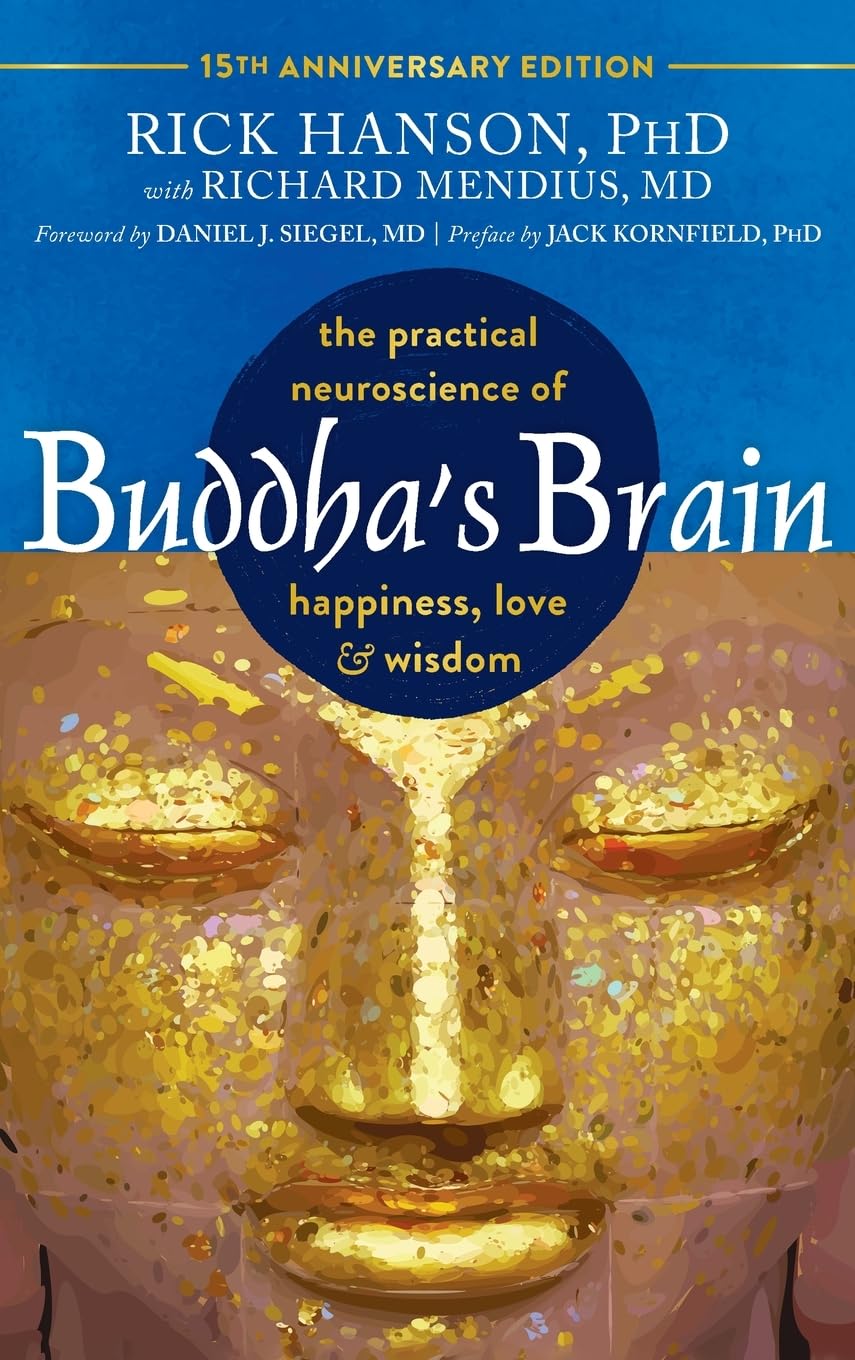
Buddha’s Brain
The Practical Neuroscience of Happiness, Love, and Wisdom
By Rick Hanson, PhD, with Richard Mendius, MD · 274 pages
The brain evolved to hang onto bad experiences like Velcro and let good ones slide by like Teflon. This book is a manual for changing that ratio, one repeated experience at a time.
What This Book Is
You sit down to meditate, and someone tells you it will calm your nervous system. But calm how, exactly — mechanically, physically, where in the body? That’s the gap Rick Hanson and Richard Mendius set out to close. Hanson is a psychologist and Senior Fellow at UC Berkeley’s Greater Good Science Center; Mendius is a neurologist who has taught at UCLA and Stanford and cofounded the Wellspring Institute for Neuroscience and Contemplative Wisdom. Both are longtime meditators, which matters — this isn’t a scientist observing practice from the outside, it’s two people who do the thing explaining why the thing works.
First published in 2009 and still in print fifteen years later with more than half a million copies sold, the book walks through the brain’s basic architecture — the amygdala, the hippocampus, the prefrontal cortex, the autonomic nervous system — and ties each structure to a specific quality Buddhist practice tries to cultivate: calm, contentment, connection. It reads less like a memoir and more like an annotated owner’s manual for the organ you’re trying to train.
The Central Argument
The book’s core claim is that your brain has a built-in negativity bias — a survival-era design choice. An ancestor who missed one edible berry lost a small snack; an ancestor who missed one predator lost their life. So the brain evolved to register threats faster, store them more vividly, and hold onto them longer than it does for positive experiences. That bias kept early humans alive, but in a modern life with few tigers and many emails, it leaves people scanning for problems that aren’t there and replaying stress long after it’s useful.
Hanson and Mendius’s answer is neuroplasticity: the finding that repeated mental activity physically reshapes neural structure. This isn’t a metaphor — it’s measurable. A well-known illustration of the principle comes from outside the book but supports its logic directly: in a study led by neuroscientist Eleanor Maguire at University College London, MRI scans of licensed London taxi drivers showed a measurably larger posterior hippocampus than in non-drivers, a structural change tied to years of memorizing the city’s street layout. If sustained mental repetition can enlarge a memory-related brain region, the book’s argument goes, sustained attention-and-compassion practice can plausibly do something comparable for circuits tied to calm and connection — the brain doesn’t just host the mind’s activity, it gets built by it.
The Buddhist Foundation: Mind as the Forerunner of All States
The book’s entire premise — that mental states are trainable, and that the mind shapes what it repeatedly does — is almost a direct restatement of the opening lines of the Dhammapada, one of the oldest and most widely translated collections of the Buddha’s sayings. Its first two verses (Yamakavagga, verses 1–2) hold that the mind is the forerunner of all mental states; that speaking or acting from a disturbed mind brings suffering the way a wheel follows the ox that pulls the cart, while speaking or acting from a peaceful mind brings well-being the way a shadow never leaves its owner.
That’s not a loose parallel Hanson draws for flavor — it’s the same claim the book spends 300 pages proving with fMRI and neurotransmitter data: what the mind repeatedly does, it becomes. The Buddha stated it as observed law twenty-five centuries before anyone could scan a brain to check.
Who Should Read This
🌟 Final Verdict
Not a book to read cover to cover in a weekend — it’s a reference you keep on the shelf and return to whenever you want the neuroscience behind a specific practice: why loving-kindness meditation might soften a grudge, why a longer exhale calms a racing heart. Read it as a companion to a daily sit, not a substitute for one, and it earns its place on the Wisdom Shelf.
Read it slowly, alongside a daily sit — the payoff isn’t a single insight but a growing vocabulary for what’s actually happening in your own head each time you practice.