Encha Ceremonial Grade Matcha Review:
A Calmer Way to Start the Day Than Coffee
Why "alert but not wired" is a real, studied state — and how a slow morning bowl of matcha can become the entry point to a calmer nervous system for the rest of the day.
🗻 Single farm in Uji, Kyoto
🌱 USDA Organic
⚖️ 60g pouch, ~30 servings
⚡ Quick Specs
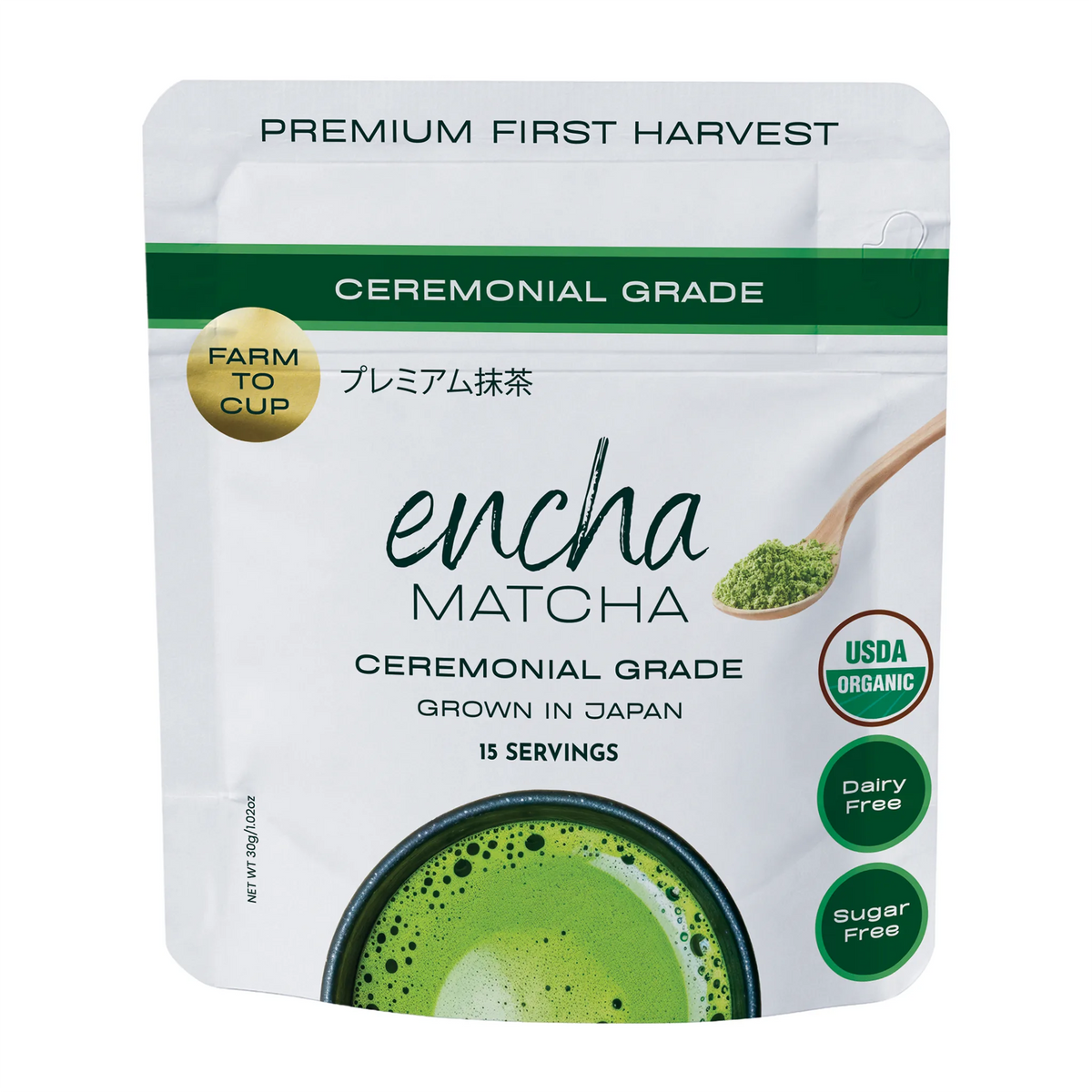
| Type | Ceremonial grade, first-harvest matcha powder |
| Origin | Uji mountains, Kyoto prefecture, Japan |
| Certifications | USDA Organic, non-GMO, annually tested for radioactivity & lead |
| Format | 60g resealable pouch (~30 servings) |
| Preparation | 1 tsp whisked into 5oz water at 160°F |
| Maker | Encha, San Francisco (founded 2014 by Dr. Li Gong) |
Why “Alert but Not Wired” Starts With What You Drink
Most people’s morning caffeine goes one of two ways: it either sharpens focus at the cost of a jittery, wired feeling, or it wears off in a crash by mid-morning. Neither state is a good foundation for a nervous system you’re trying to keep calm all day. Matcha — whole tea leaf ground into powder, not steeped and discarded — delivers caffeine alongside something coffee doesn’t have: a meaningful dose of L-theanine, an amino acid that changes how that caffeine actually feels in the body.
Encha’s ceremonial grade matcha is one of the more transparently sourced options in a category where “ceremonial grade” is often just a marketing label with no real standard behind it — worth understanding both the ritual and the science before adding it to a morning practice.
1. The L-Theanine and Caffeine Science
The caffeine-plus-L-theanine combination found naturally in matcha has been studied specifically for this “alert but not wired” effect. In a randomized, placebo-controlled crossover study by Haskell, Kennedy, Milne, Wesnes & Scholey (2008), published in Biological Psychology, participants given L-theanine and caffeine together showed faster reaction times and better sustained attention than either compound alone — while also reporting less of the jittery, anxious quality that caffeine alone tends to produce. Later EEG research found L-theanine increases attention-related alpha brain wave activity, a pattern associated with a state researchers describe as “alert relaxation” — focused, but not agitated.
This is a meaningfully different profile from a straight shot of coffee, which delivers caffeine with none of that buffering effect. It’s also why matcha has functioned as a focus aid inside contemplative practice for centuries, long before anyone had a word for L-theanine.
2. Whisking Matcha as a Morning Practice
Matcha rewards slowness in a way instant coffee doesn’t. Whisking the powder into water — watching it foam, waiting for the color to settle — takes maybe ninety seconds, but those ninety seconds are themselves a small concentration practice: one task, full attention, nothing else happening. Treat the whisking as the first “practice” of the day rather than a chore standing between you and the caffeine. If you already sit for a few minutes of breath awareness in the morning, matcha pairs naturally right before or right after it — the alert-relaxation state it produces tends to carry directly into a sit.
3. Why Encha’s Sourcing Stands Out
Encha’s founder, Dr. Li Gong, left a Silicon Valley VP role in 2014 after tasting organic matcha at a single family farm in the Uji mountains of Kyoto — a farm that had already been organic since 1987, long before that was a marketable claim. Encha still sources from that same farm today, publishes its organic certificate and annual radioactivity/heavy-metal test results directly on its site, and was independently tested as part of a ConsumerLab green tea report cited in TIME Magazine, which found no contamination by lead or pesticides. That level of published, checkable sourcing is genuinely rare in a matcha market where “ceremonial grade” often means very little.
Pros & Cons: An Honest Assessment
✅ What Works Well
- +Single-farm sourcing with unusual transparency — published organic certificate and radioactivity/lead testing
- +Independently reviewed favorably by multiple matcha-specific test sites, cited in a TIME Magazine piece via ConsumerLab testing
- +True first-harvest ceremonial grade, not relabeled culinary-grade powder
- +Resealable pouch keeps the fine powder from clumping
❌ Worth Knowing
- −Still contains real caffeine (roughly half a cup of coffee’s worth per serving) — not suitable late in the day
- −Priced higher per serving than culinary-grade matcha or standard green tea
- −Ceremonial grade is meant for whisking with water alone; those wanting a milky latte should look at Encha’s separate latte-grade line
Who Is This For?
FAQ: Encha Ceremonial Grade Matcha Questions
How much caffeine is in Encha matcha?
Roughly half a cup of coffee’s worth per serving, so it is best kept to the morning and early afternoon.
How do you prepare ceremonial grade matcha?
Whisk about one teaspoon into 5 oz of water at roughly 160°F until it foams. Ceremonial grade is meant to be drunk with water alone.
Can you use ceremonial matcha in lattes?
You can, but it is designed for whisking with water. If you want a milky latte, Encha makes a separate latte-grade line.
🌟 Final Verdict: Encha Ceremonial Grade Matcha
Encha Ceremonial Grade Matcha earns its price with genuine transparency — a single traceable farm, published safety testing, and a caffeine-plus-L-theanine profile backed by real research on “alert relaxation.” If your morning routine already includes a few minutes of quiet, this is a well-sourced way to make that time do double duty.