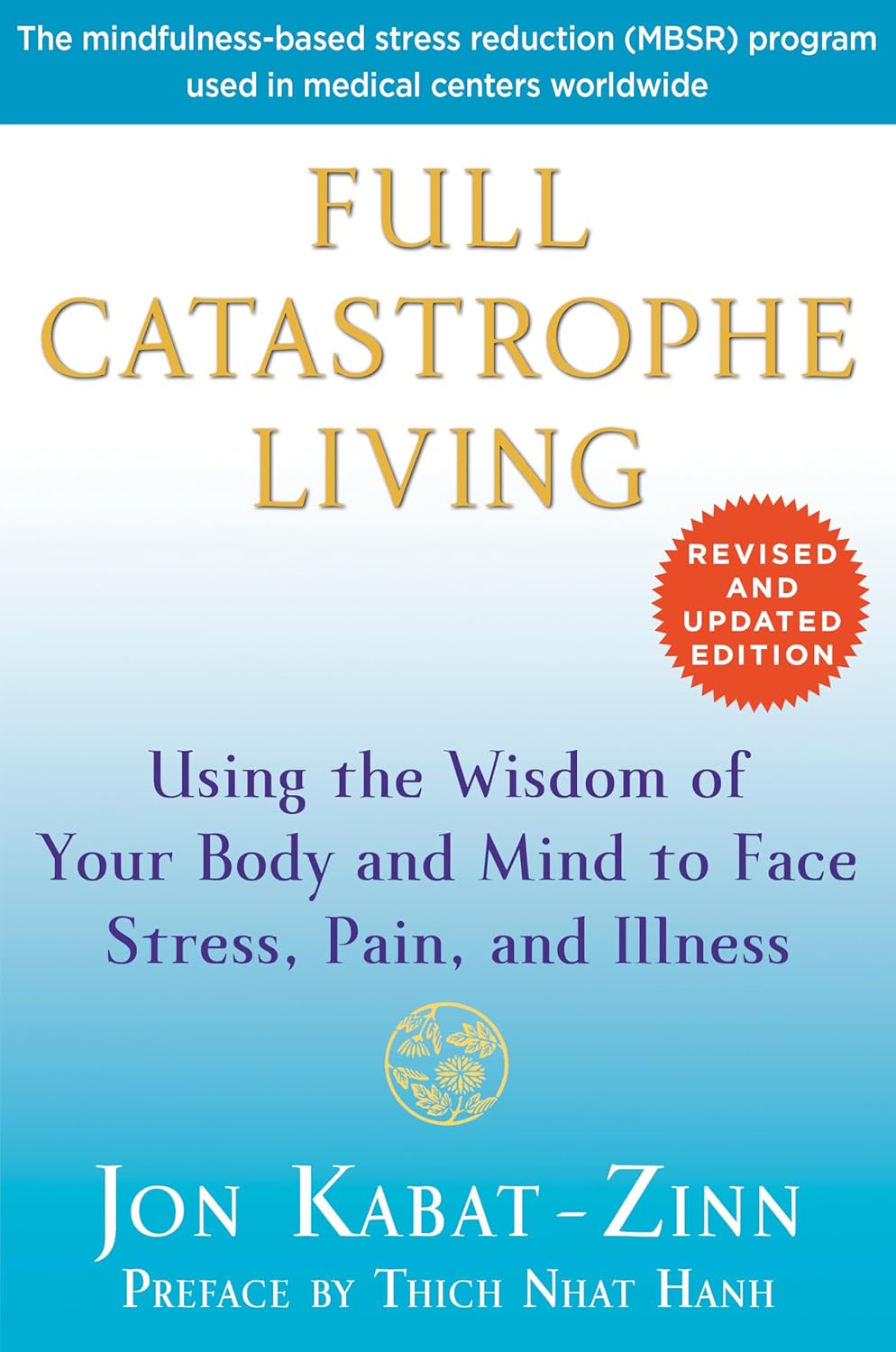
Full Catastrophe Living
Using the Wisdom of Your Body and Mind to Face Stress, Pain, and Illness
By Jon Kabat-Zinn, PhD · Preface by Thich Nhat Hanh · 720 pages
The book that brought mindfulness into medicine. Not a popular introduction — a complete manual. Everything MBSR is, this book explains, teaches, and documents.
What This Book Is
Full Catastrophe Living is the foundational text of Mindfulness-Based Stress Reduction — the eight-week program Jon Kabat-Zinn developed at the University of Massachusetts Medical School beginning in 1979, which is now offered in more than 740 hospitals, clinics, and stand-alone programs worldwide. The title comes from Zorba the Greek, who describes his life with all its chaos, pain, and imperfection as “the full catastrophe” — not as complaint but as celebration. The book teaches you to meet your own full catastrophe the same way.
At 720 pages, this is not a casual read. It is a comprehensive manual: the complete eight-week MBSR curriculum in written form, the scientific research documenting its clinical outcomes, and Kabat-Zinn’s thinking about the nature of mind, body, and healing built over decades of clinical work. If Wherever You Go, There You Are is a door into the practice, Full Catastrophe Living is the entire building. The preface is written by Thich Nhat Hanh, who describes Kabat-Zinn’s work as one of the most important contributions to the meeting of East and West.
This is the book physicians recommend when medication is insufficient. It was written for people living with chronic pain, anxiety disorders, serious illness, and the kind of stress that has become structural rather than situational. It assumes you have real difficulty and teaches you how to work with it directly.
The Central Argument
Kabat-Zinn’s central argument is that suffering and difficulty are not problems to be solved before life can begin. They are the material of life — the full catastrophe — and the question is not how to eliminate them but how to meet them. Mindfulness is the capacity to be present with what is actually happening, including what is painful, without adding the secondary layer of resistance and struggle that amplifies suffering beyond the original difficulty.
The book teaches this through five core practices: the body scan, sitting meditation, mindful yoga, walking meditation, and mindful eating. Each is described in detail, with the instruction and the clinical reasoning behind it. Kabat-Zinn does not ask you to believe the practices will help. He asks you to try them for eight weeks and observe what happens. The approach is empirical from the beginning: your own direct experience is the laboratory.
The book is also honest about what mindfulness cannot do. It does not promise the elimination of pain or the resolution of illness. It promises a fundamentally different relationship to pain and illness — one in which the suffering that comes from resisting what cannot be changed is reduced, and the capacity to respond wisely to what can be changed is increased. This distinction — between pain and the suffering layered on top of it by the mind — is one the Buddha made in the Pali Canon 2,500 years ago. Kabat-Zinn makes it in the language of clinical medicine. They are describing the same thing.
💡 The science: Full Catastrophe Living inspired not only MBSR but mindfulness-based cognitive therapy (MBCT) and mindfulness-based pain management (MBPM) — two of the most rigorously studied psychological interventions now available. MBSR has been documented to produce positive effects on the brain, on gene expression, on cellular factors associated with aging, and on immune function. A landmark study by Kabat-Zinn and colleagues published in Psychosomatic Medicine found that MBSR training combined with phototherapy cleared psoriasis four times faster than phototherapy alone — a finding demonstrating that the mind’s relationship to the body is not metaphorical but physiological, with measurable effects on healing outcomes. MBSR is now covered by insurance in many countries as a clinically validated treatment for chronic pain, anxiety, and depression.
Where It Comes From
Kabat-Zinn learned meditation directly from Philip Kapleau, a Zen teacher who trained in Japan for thirteen years; from Thich Nhat Hanh; and from Seung Sahn, a Korean Zen master. He was a founding member of the Cambridge Zen Center. His doctoral training was in molecular biology at MIT. MBSR was built by taking the core of what these teachers taught — particularly the body scan from the Burmese Vipassana tradition and mindful movement from the Zen tradition — and redesigning it for a hospital setting, stripped of religious framing, and subjected to clinical measurement.
This origin matters for how you read the book. Kabat-Zinn did not invent the practices. He translated them. The body scan, the sitting meditation, the walking meditation, the attention to breath and body — all of these trace directly to the Buddha’s teaching in the Satipatthana Sutta. What changed was the context and the language. What did not change was the mechanism: sustained, non-judgmental attention to present-moment experience as a means of understanding and transforming one’s relationship to difficulty.
Who Should Read This
🌟 Final Verdict
Full Catastrophe Living is the most comprehensive and clinically grounded mindfulness book available. It is not the most accessible — at 720 pages it asks for real commitment. But if you are dealing with chronic difficulty of any kind, or if you want to understand the practice at depth rather than in outline, this is the book that contains everything.
It is also, quietly, one of the most important books of the past fifty years. It changed what medicine thinks is possible. It introduced millions of people to practices that trace directly to the Buddha’s teaching. And it did so in a language that required no belief, no background, and no cultural translation. That achievement is not small.