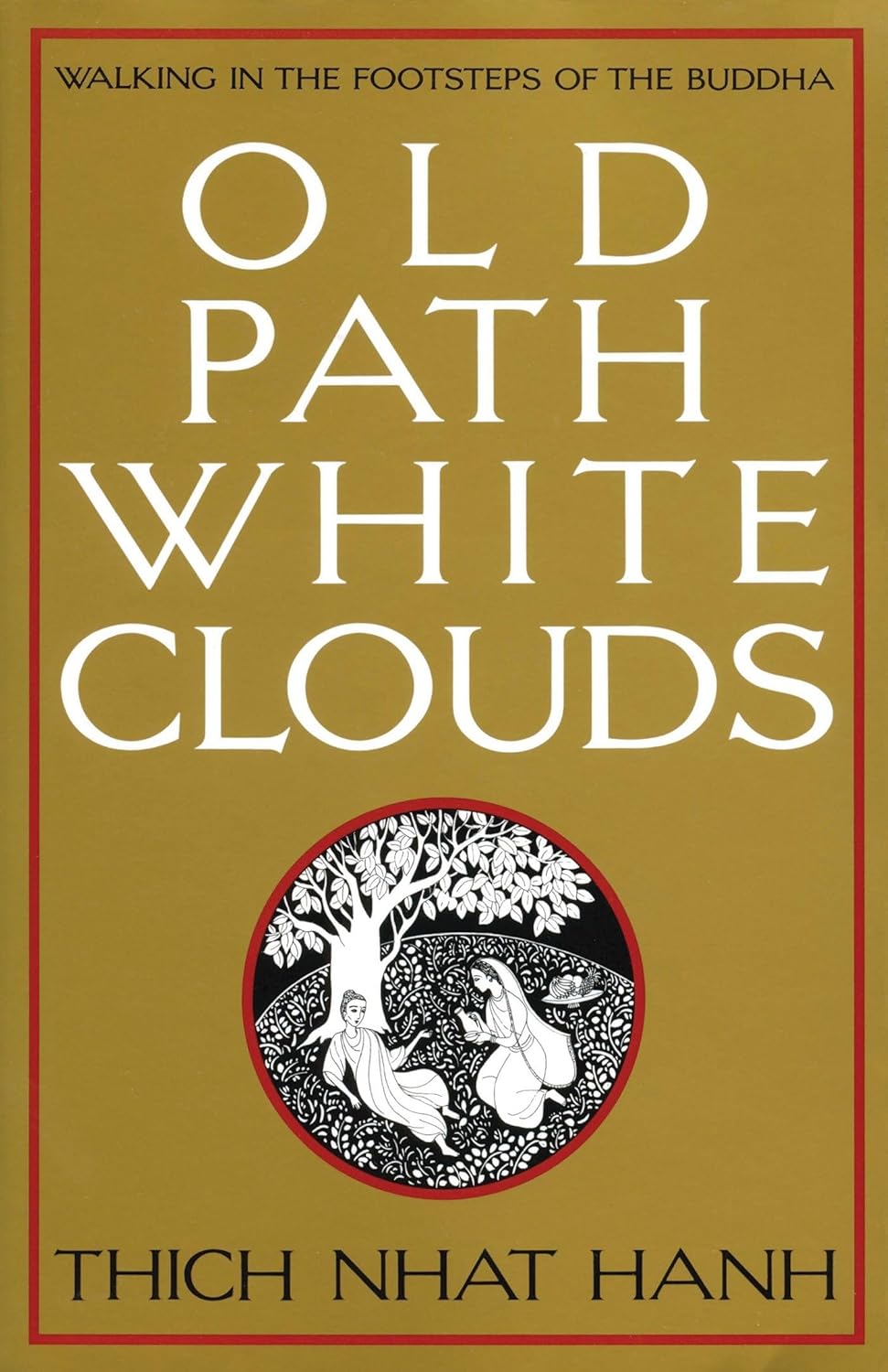
Old Path White Clouds
Walking in the Footsteps of the Buddha
By Thich Nhat Hanh · Illustrated by Nguyen Thi Hop · 600 pages
Every practice on this site traces back to one person. This is his story — told slowly, carefully, from the sources that recorded it.
What This Book Is
Old Path White Clouds is unlike every other book on this shelf. It is not about how to meditate, how to breathe, or how to manage stress. It is the story of the man who discovered all of it — Siddhartha Gautama, who became the Buddha — told from his birth in the Shakya kingdom through eighty years of life, teaching, conflict, and loss, to his final hours under the sala trees at Kusinara.
Thich Nhat Hanh spent years researching and writing this book, drawing directly from 24 Pali, Sanskrit, and Chinese primary sources — the oldest surviving records of the Buddha’s life and teaching. The bibliography at the back of the book lists them all. This is not creative invention or spiritual speculation. Every major event, every teaching, every named disciple in the book has a source in the canonical literature. Thich Nhat Hanh’s contribution was to weave those sources into a single narrative that reads as naturally as a novel.
The story is told partly through the eyes of Svasti — a young buffalo boy who encountered the Buddha on the day of his enlightenment, brought him grass to sit on, and later became one of his monks — and partly through the eyes of the Buddha himself. This dual perspective allows Thich Nhat Hanh to show both the human experience of encountering the teaching and the inner world of the teacher himself: his doubts, his grief, his joy, his patience with disciples who repeatedly misunderstood him.
Why This Book Matters for Your Practice
When you follow the breath, you are doing something the Buddha taught. When you notice impermanence in the rising and falling of a single breath, you are practicing what he described in the Anapanasati Sutta. When you sit with a difficult emotion rather than suppressing it or acting it out, you are following the instruction he gave to countless students over forty-five years of teaching.
Most people who practice mindfulness today do not know the story of where these practices came from, who developed them, or why. They know the techniques but not the person behind them. This matters more than it might seem: knowing the source changes how you hold the practice. It is the difference between following a method and following a path — a path that someone walked first, that has been tested by thousands of people across 2,500 years, and that continues because it works.
Old Path White Clouds gives you that context. After reading it, the practices you use daily — the breath, the walking, the sitting with what is difficult — are no longer techniques you read about in a wellness book. They are instructions from a specific person, given in specific circumstances, to specific students who needed exactly what you need. The Anapanasati Sutta was not written by a committee. It was taught by a man sitting under trees in the Ganges plain, to monks who were struggling with exactly the same difficulties that modern practitioners struggle with.
The Buddhist Foundation: The Buddha’s Life Story
The book opens before Siddhartha’s birth and follows him through his sheltered childhood as a prince in the Shakya kingdom, his first encounter with sickness, old age, and death, and his decision to leave his family and palace to seek an answer to suffering. It follows him through six years of severe ascetic practice with other seekers, his eventual rejection of that approach, the night of his enlightenment under the Bodhi tree, and the moment he decided to teach what he had found rather than remain silent.
From there the book follows forty-five years of teaching — the founding of the sangha, the conversion of major disciples including Sariputta, Moggallana, Mahakassapa, and Ananda, the challenges from Devadatta, the deaths of close companions, the questions of kings and ordinary people, and the development of the monastic community that would carry the teaching forward. The final chapters describe the Buddha’s last journey north, his final illness, his last teachings to Ananda, and his death at Kusinara. Thich Nhat Hanh writes these chapters with the same quiet attention he brings to all of it — no drama added, no miracle inflated, just the careful record of what the sources say.
Throughout the book, the core teachings arise naturally from the narrative rather than being introduced as doctrinal summaries. The Four Noble Truths appear the first time the Buddha teaches, in the Deer Park at Isipatana. The teaching on not-self arises in response to a specific question. The instruction on loving-kindness meditation appears in the context of monks being frightened in a forest. Every teaching has a human occasion that makes it vivid and memorable in a way that doctrinal presentation never does.
Who Should Read This
🌟 Final Verdict
This is the book that answers the question underneath all the other questions on this shelf: who was this person, and how did he find what he found? It is not a self-help book. It is not a meditation manual. It is the primary source — the story of where all of it began, told by someone who spent decades in the tradition that preserved it and years researching the texts that recorded it.
At 600 pages it is the longest book on this shelf. It is also the one most likely to change how you understand everything else on it. Thich Nhat Hanh himself wrote in the afterword: “If the Buddha appears in this book as a man close to us, it is partly due to recounting such difficulties.” He does appear close. That is the book’s greatest achievement.