Traditional Medicinals Organic Nighty Night Tea Review:
A Wind-Down Ritual Backed by Real Herbal Science
Why a caffeine-free evening tea can become the physical cue your nervous system needs to shift out of "still doing" and into "allowed to rest."
🌱 USDA Organic
🫖 16 tea bags per box
⏱️ Steep 10–15 min
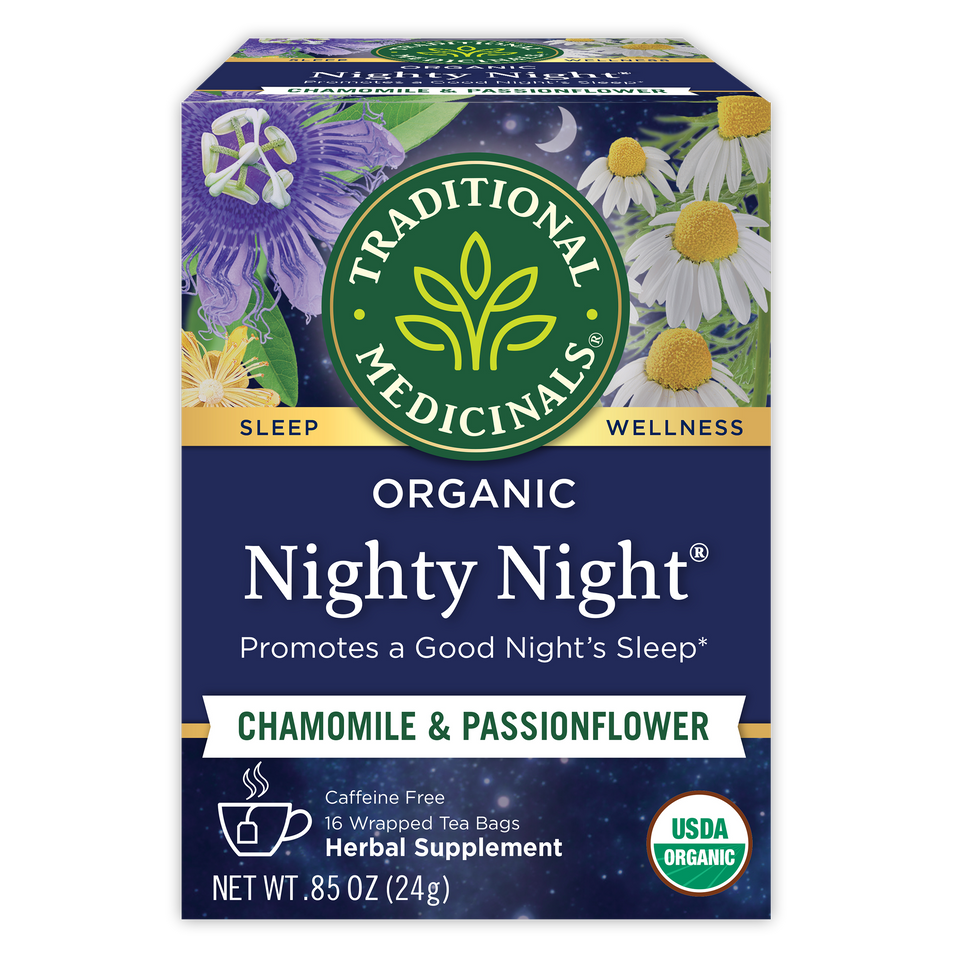
⚡ Quick Specs
| Type | Certified organic herbal tea, caffeine-free |
| Key herbs | Passionflower, chamomile, catnip, hops, linden |
| Certifications | USDA Organic, Non-GMO Project Verified, Kosher |
| Format | 16 tea bags per box (also sold in 96-ct case) |
| Steep time | 10–15 minutes, covered |
| Maker | Traditional Medicinals, Sebastopol, California (est. 1974) |
Why an Evening Cue Matters More Than the Herbs
Most evening wind-down advice tells you to simply “stop” — stop scrolling, stop working, stop thinking. But the nervous system doesn’t take instructions that abstract. It responds to physical cues: dim light, a slower voice, a warm cup in your hands. That’s the real job of an evening tea ritual — not the herbs alone, but the five quiet minutes of steeping that give your body a concrete signal that the active part of the day is over.
Traditional Medicinals Organic Nighty Night Tea is one of the most-used teas in exactly that role, and it’s worth understanding why it works before adding it to your own practice.
1. What the Research Says About Passionflower and Chamomile
Nighty Night’s lead herb is passionflower (Passiflora incarnata), traditionally used as a mild nervine — an herb thought to calm nervous tension rather than force sedation. This isn’t just folk history: a double-blind, placebo-controlled trial by Akhondzadeh et al. (2001), published in the Journal of Clinical Pharmacy and Therapeutics, compared passionflower extract against a standard anti-anxiety medication in adults with generalized anxiety disorder. Passionflower performed comparably to the medication in reducing anxiety symptoms over four weeks, with a slower onset but noticeably fewer next-day performance side effects. Chamomile, the blend’s second key herb, has separately been studied for mild anti-anxiety and sleep-supportive effects in general population trials.
None of this means a cup of tea works like a prescription sedative — it doesn’t, and the study above used a concentrated extract, not a tea bag. What it does support is the tea’s traditional role: a mild, non-habit-forming nudge toward a calmer state, most effective when it’s paired with the ritual of slowing down, not used as a substitute for it.
2. Turning the Steep Into a Practice
The most effective way to use this tea isn’t to drink it passively while doing something else. Treat the steep time itself as a short practice: put the phone in another room, sit while the tea steeps for the full 10–15 minutes, and let that be your transition — from the nervous system’s “doing” mode into “resting” mode — before you even take the first sip. The tea supports the shift; the stillness you give it during those minutes is what actually completes it.
3. Who Is Behind Traditional Medicinals
Traditional Medicinals was founded in 1974 by herbalist Rosemary Gladstar and community activist Drake Sadler, and it’s still an independent, family-and-employee-held company — not folded into a multinational beverage conglomerate, which is a genuine point of difference in this category. It’s a Certified B Corporation, sources the large majority of its herbs organically, and has paid into Fair Trade-certified herb-growing communities since the 1990s. This is the kind of sourcing story worth knowing before you trust a company with something you’re putting in your body every night.
Pros & Cons: An Honest Assessment
✅ What Works Well
- +Herbalist-formulated with a traditional-use track record, not a novelty blend
- +USDA Certified Organic and Non-GMO Verified
- +Caffeine-free, gentle enough for a nightly habit
- +Compostable tea bags — no plastic
- +Affordable enough to use daily without it feeling precious
❌ Worth Knowing
- −Effect is mild and cumulative — not a fast-acting sedative
- −Flavor leans herbal/floral; not for people who want a sweet dessert-style tea
- −The maker recommends not using this tea continuously for more than two weeks without a break, and advises against use during pregnancy or breastfeeding unless directed by a doctor — treat it as an evening ritual tool, not an everyday-indefinitely habit
- −Contains chamomile — not suitable if you have a ragweed/Asteraceae allergy (Nighty Night Extra, without chamomile, is the brand’s alternative)
Who Is This For?
FAQ: Traditional Medicinals Organic Nighty Night Tea Questions
Is Nighty Night tea safe to drink every night?
The maker recommends not using it continuously for more than two weeks without a break, and advises against it during pregnancy or breastfeeding unless a doctor directs it. Treat it as an evening ritual tool rather than an indefinite daily habit.
Does Nighty Night tea contain caffeine?
No. It is a caffeine-free herbal blend of passionflower, chamomile, catnip, hops and linden, gentle enough for an evening routine.
Who should avoid this tea?
Anyone with a ragweed or Asteraceae allergy should skip it because it contains chamomile. The brand makes a chamomile-free alternative called Nighty Night Extra.
🌟 Final Verdict: Traditional Medicinals Organic Nighty Night Tea
Traditional Medicinals Organic Nighty Night Tea isn’t a dramatic fix — and that’s the point. It’s a low-cost, well-sourced, herbalist-formulated tool for building a consistent evening cue, backed by real (if modest) clinical evidence on its lead herb. If you already have a sitting or sleep practice and want a physical anchor for the transition into it, this is a genuinely well-made place to start.