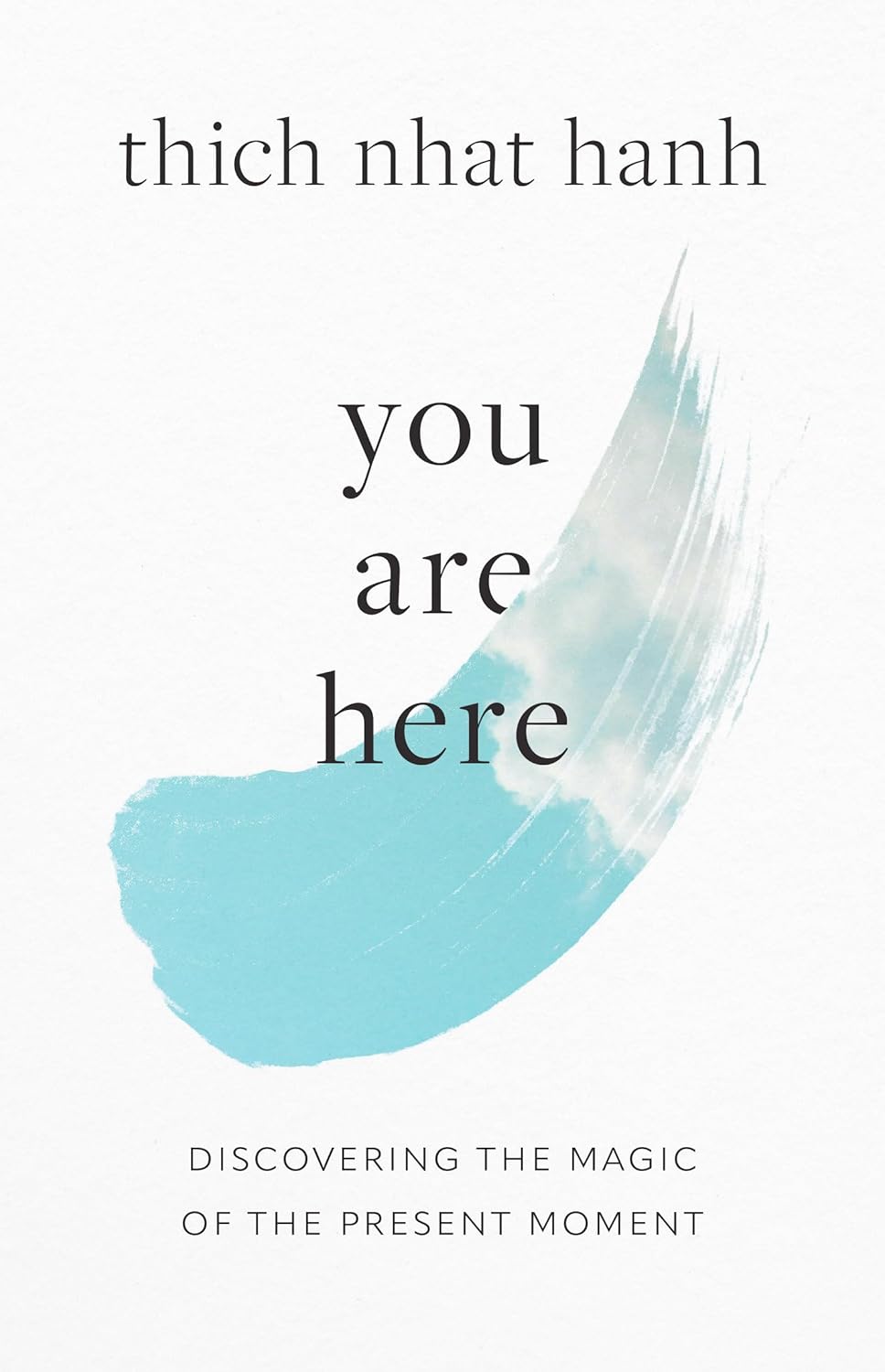
You Are Here
Discovering the Magic of the Present Moment
By Thich Nhat Hanh · 160 pages
The mind spends roughly half its waking hours somewhere other than the present moment. This book is the clearest instruction available on how to close that gap — one breath at a time.
What This Book Is
You Are Here originated as a retreat Thich Nhat Hanh led for Western practitioners — people unfamiliar with Buddhist terminology and practice, coming from daily lives full of schedules, screens, and background noise. The book preserves that directness. There is almost no abstract theory. There are instructions: how to breathe, how to walk, how to sit with a difficult emotion without being controlled by it, how to listen to someone without planning your response while they speak.
At 160 pages, it can be read in a single afternoon. Its central claim is simple: the present moment is not a technique you apply to life. It is where life actually happens. And the breath is the most reliable available path back to it — always present, always accessible, requiring no equipment and no preparation.
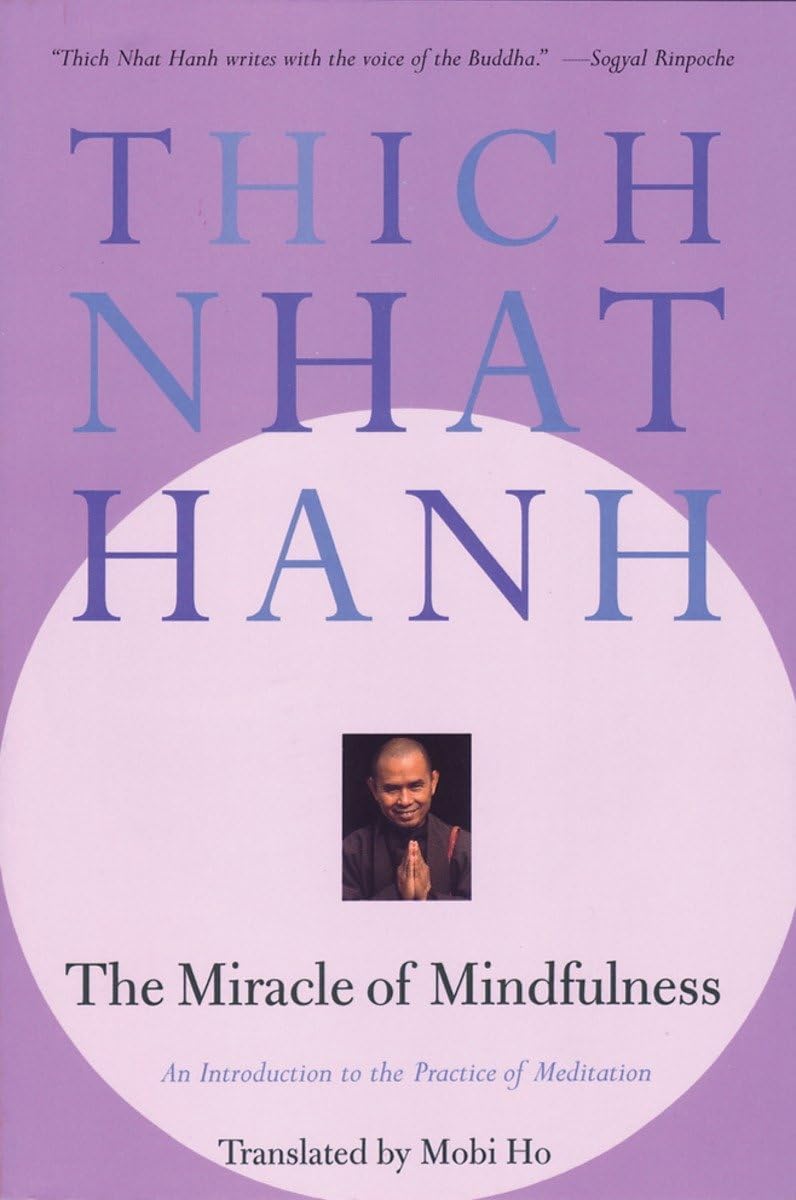
Where The Miracle of Mindfulness addresses the practitioner who wants to understand the principles behind the practice, You Are Here addresses the practitioner who wants to begin today. It is more immediate, more direct, and in some respects more applicable to daily life in a modern environment.
The Central Argument
Thich Nhat Hanh opens with an observation that sounds simple until you sit with it: most of us are almost never fully present. The body is here. The mind is in yesterday’s conversation, tomorrow’s deadline, or a loop of low-grade anxiety that has no specific object. This gap between where the body is and where attention is — what he calls “non-presence” — is, he argues, the source of most ordinary suffering. Not dramatic trauma. The daily friction of a mind that is habitually elsewhere.
The instruction he offers is not complex: breathe in, know you are breathing in. Breathe out, know you are breathing out. This is not a metaphor or a visualization. It is a literal description of what to do, and the precision is the point. When attention is fully occupied with the physical sensation of the breath, the machinery of mental absence — the planning, the replaying, the comparing — does not have room to run. The breath and the wandering mind cannot occupy the same moment at the same time.
He extends this to walking: each step as a complete arrival. To eating: each bite as its own event. To listening: full attention without preparing a response. In each case, the instruction is the same — bring attention fully to what is actually happening, as it is happening. He calls this “dwelling in the present moment,” and distinguishes it explicitly from relaxation or stress management. It is not trying to feel better. It is trying to be actually present for your own life.
💡 The neuroscience: Judson Brewer and colleagues at Yale, publishing in PNAS in 2011, found that experienced meditators showed significantly reduced activity in the main nodes of the default mode network — the medial prefrontal cortex and posterior cingulate cortex — across all meditation types they studied. The default mode network is the brain’s baseline state of self-referential wandering: replaying the past, projecting into the future, evaluating the present against expectations. When present-moment attention is sustained, this network quiets. What Thich Nhat Hanh describes as “dwelling in the present moment” is, at the neural level, a measurable reduction in default mode activity.
The Buddhist Foundation: Presence as Practice, Not Technique
Thich Nhat Hanh is a Vietnamese Zen Buddhist monk, ordained in 1949, and the founder of Plum Village monastery in France — the largest Buddhist monastery in Europe. He was nominated for the Nobel Peace Prize by Martin Luther King Jr. in 1967 for his peace work during the Vietnam War. His teaching lineage runs directly from the Vietnamese Thien tradition, which itself descends from the Chinese Chan school and ultimately from the Indian traditions the Buddha established.
The practices in You Are Here are rooted in the Satipatthana Sutta — the Buddha’s discourse on the four foundations of mindfulness. The first foundation is the body, and breath awareness is the primary entry point: “Breathing in, he knows he is breathing in. Breathing out, he knows he is breathing out.” This is not a modern adaptation or a secular simplification. It is the instruction the Buddha gave, transmitted intact across 2,500 years of practice, reformulated by Thich Nhat Hanh into language a Western reader can follow without Buddhist background.
What distinguishes this teaching from mindfulness as it is often presented in wellness culture is its framing: presence is not a technique for producing calm. It is the fundamental condition of being actually alive to your own experience rather than running on automatic. The calm is a consequence, not the goal. This distinction — subtle on paper, significant in practice — shapes everything about how the instructions are given and what they point toward.
Who Should Read This
🌟 Final Verdict
Where The Miracle of Mindfulness explains why presence matters, You Are Here shows you how to find it in the next five minutes. It is Thich Nhat Hanh at his most direct — instruction distilled from decades of practice into language anyone can follow. The breath, the step, the moment. That is all it asks. It is also all it needs to be.
Keep it somewhere you will see it. It is the kind of book that earns a second reading not because the content is dense, but because the reminder is one you will need again.