
Dishes are the chore nobody puts on a wish list. They show up three times a day, they are never finished, and most of us rush through them with a podcast in our ears and our minds somewhere else entirely. Mindful dishwashing is the practice of doing that same task with your attention in the room, on purpose, for the few minutes it takes.
It needs no cushion, no timer, and no extra time. The sink is already waiting.
What Research Says About Mindful Dishwashing
A team led by Adam Hanley and colleagues at Florida State University, published in 2015 in the journal Mindfulness under the title “Washing Dishes to Wash the Dishes,” tested this idea directly. Fifty-one undergraduates were randomly assigned to read one of two short passages. Twenty-six read a mindful dishwashing passage that guided them to pay attention to the experience itself, and twenty-five read a descriptive passage of about the same length that explained how to wash dishes correctly, such as how to prepare the water and in what order to wash items. Everyone then washed the same 18 clean dishes in a lab.
Afterward, the mindful group reported higher state mindfulness than the control group, with the clearest difference in curiosity. Nervousness decreased and inspiration increased in the mindful group. Some results were less striking: overall positive and negative mood did not change significantly, and one part of mindfulness, the ability to step back from your thoughts, did not differ between groups. The mindful group also overestimated how long they had been washing, even though the actual times were the same, which is a small hint that attention can stretch the feeling of time.
It is worth keeping the limits in view. The participants were students, the task was a single short session, and the results were self-reported, and the authors point out that mindfulness was measured only after the task, so the design cannot show whether the mindful passage raised it or the control passage lowered it. They also note that the mindful wording may have hinted that rushing is bad, which could have shaped the answers, and that washing clean dishes in a lab differs from a real sink full of last night’s pans. This is a small, early finding and not proof of a lasting effect.
There is a broader reason to pay attention to routine tasks. In a 2010 paper in Science, Matthew Killingsworth and Daniel Gilbert at Harvard University used a smartphone app to ask 2,250 adults what they were doing, what they were thinking about, and how they felt at random moments. People’s minds were wandering 46.9 percent of the time, and they reported being less happy when their minds wandered than when they were focused on what they were doing. That does not mean that every wandering thought is harmful, and the study cannot prove cause and effect. But it fits the everyday intuition behind mindful dishwashing: if nearly half of our waking life is spent somewhere else, then the most repetitive parts of the day are an obvious place to practice coming back. But it supports something simple: the same ordinary task can feel different depending on where your attention sits while you do it.
The Buddhist Source Behind This Practice
The Satipatthana Sutta (Majjhima Nikaya 10), the Buddha’s central teaching on mindfulness, describes applying clear comprehension to ordinary movement: in going forward and back, in looking ahead and away, in eating, drinking, chewing, and savoring. Washing dishes is not named in the list, but the principle is exactly the same. Everyday actions are not a break from the practice. They are the practice.
The same passage returns again and again to one phrase: in each activity, the practitioner acts with clear awareness of what is being done. In modern language, that means knowing that your hands are in warm water while your hands are in warm water. It is a modest standard. You do not need to feel peaceful or hold a special thought; you only need to know where you are and what you are doing, and to notice when you have left.
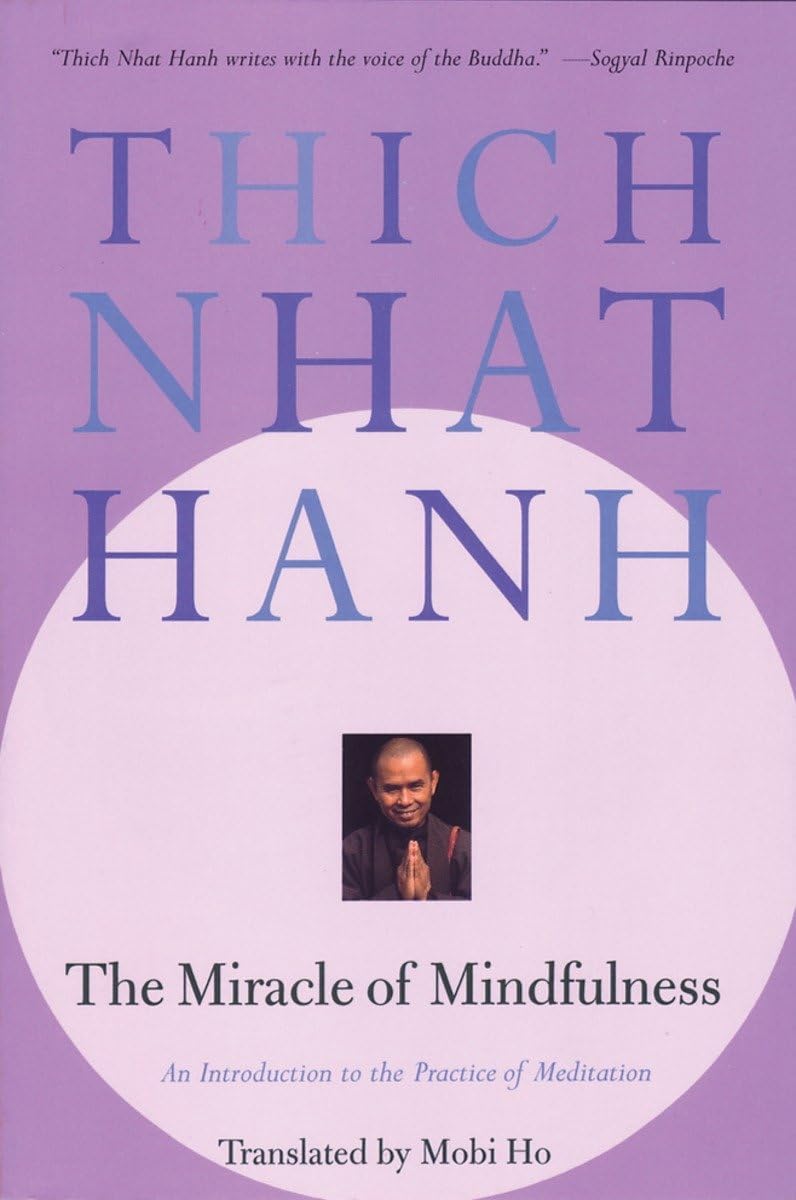
The Vietnamese Zen teacher Thich Nhat Hanh made this famous with a single question in The Miracle of Mindfulness: who is washing the dishes? If you wash a bowl only to get to the next thing, you are not really there, and the time becomes something to endure. If you wash it simply to wash it, the time is yours.
His point is easy to misread as a rule that chores must be enjoyed. It is closer to an observation about how the mind works: the time you spend washing a bowl is going to pass either way, and the only choice is whether you are present for it. Presence is available in the unglamorous minutes as readily as in a retreat hall, and arguably more usefully, since these are the minutes where most of life actually happens. You can treat that as a claim to test, not a belief to adopt: try one week of a single mindful minute at the sink and see what you notice.
How to Practice Mindful Dishwashing
- Start with one pot or one bowl. Don’t turn it into a big project. A single dish is enough to begin.
- Put the phone and the podcast away. Let the sounds of the kitchen be the soundtrack for a few minutes.
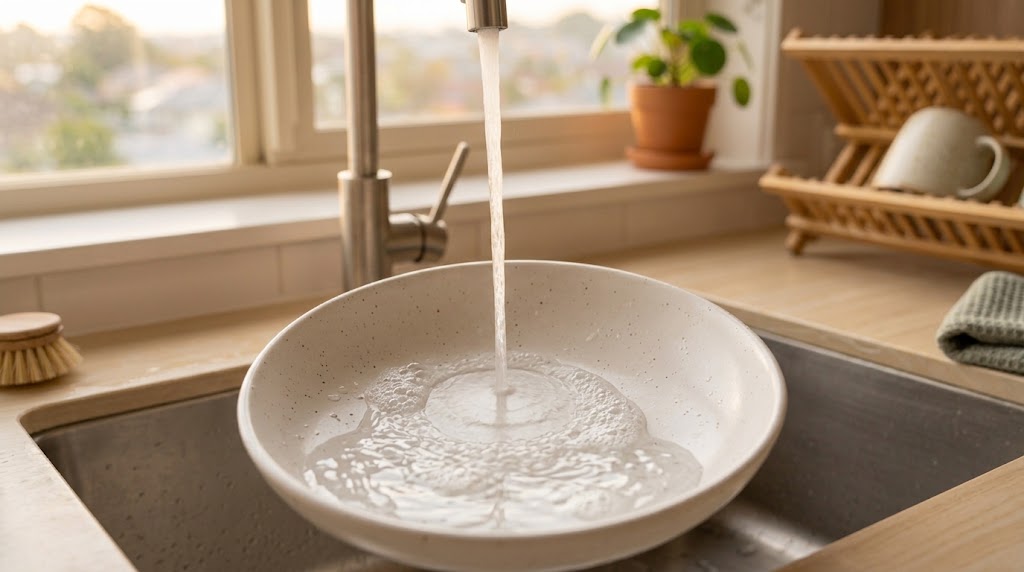
- Feel the water. Notice its temperature on your hands, the slickness of the soap, and the weight of the dish.
- Take one slow breath before you start. It marks the moment as different from the rush before it.
- When the mind wanders, return to your hands. That return is the whole exercise, and it counts every time you do it.
- Finish with a pause. When the last dish is in the rack, stand for one breath and look at what you’ve done.
Making It Work in a Real Kitchen
Few of us wash dishes in perfect silence. If you share a kitchen, other people will talk, a child may need something, and the pan will not be as clean as you wanted. You are allowed to keep part of your attention on the people around you; the practice is not about shutting them out but about being present for the whole scene, hands included. If you use a dishwasher, the same attention can go into loading it, rinsing a single cup, or wiping the counter afterward. The point is not the sink but the habit of being where you are.
If standing at a sink is uncomfortable, sit on a stool, use warm gloves if the water is hard on your hands, or choose another small task that you already do daily. Mindfulness does not require pain or perfection. It is also fine to start with a rule as small as “the first minute of the dishes is mine.” Many people find that a minute of attention naturally grows, and that the dishes themselves feel lighter when the mind has not already moved on to the next thing.
Doing It with Others
Dishes can also be a shared practice. A household that agrees to wash up in quiet for the first few minutes, with no screens and no tasks being discussed, often finds the kitchen feels different. Children can join by being asked to notice something: the warmth of the water, the sound of a glass, the feel of a dry towel. Keep it light and playful, since the practice works against its own purpose if it turns into one more thing to get right. If you live alone, the same few minutes can be a small appointment with yourself at the end of the day, a way to mark a clear line between work and rest.
A Three-Minute Version
Try this the next time you have a few dishes. Stand with both feet on the floor and take one slow breath. For the first minute, attend only to touch: temperature, pressure, the slippery film of soap. For the second, attend to sound: running water, the tap of a plate against the rack, the room behind it. For the third, attend to the whole body standing at the sink, shoulders and jaw included, and let go of any tension you find. When you finish, look at the clean dishes for a moment. This sequence is a practical suggestion for building the habit, not a protocol from the study above.
Mindful dishwashing won’t make the dishes disappear. What it can do is turn one of the least loved minutes of the day into a small, reliable pause, three times a day, with nothing extra to buy and nowhere extra to go. If you try it for a week and notice nothing, that is useful information too; the invitation, in the spirit of the Kalama Sutta, is to test it for yourself and keep what proves worthwhile.
If you’d like to bring the same attention to the table, read Mindful Eating and Tea Meditation.
This article is part of the Learn library at Buddhism with Maitreya Dharma, where modern neuroscience and the Buddha’s teachings meet in practical, everyday language — no background in Buddhism required.