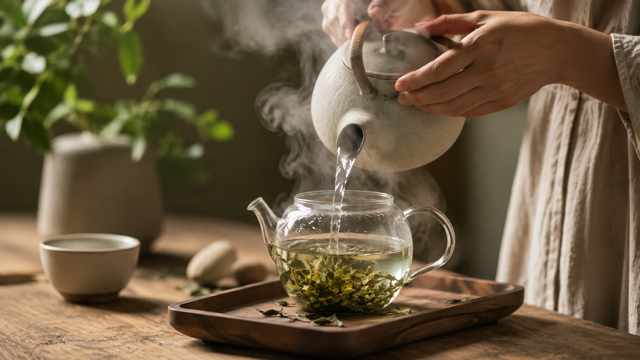
Most people already have a small pocket of quiet built into their day and don’t notice it — the few minutes it takes to make a cup of tea. That time usually gets treated as dead time, something to fill with a phone screen or a mental to-do list while the water heats. Tea meditation is simply the practice of reclaiming those minutes on purpose — treating the brewing and drinking of tea itself as the meditation, not the pause before one.
It requires no cushion, no special posture, and no extra time carved out of an already full day. The ritual you’re probably already doing becomes the practice.
Why an Ordinary Ritual Works as Well as a Formal Sit
A small study by Nishikori, Taruoka, Kajita and colleagues, published on January 5, 2026 in Cureus (volume 18, issue 1, e100865), tested a simplified Japanese tea ceremony with ten palliative care staff at Ashiya Municipal Hospital in Hyogo, Japan: four occupational therapists, two nurses, a clinical psychologist, a pharmacist and two physicians, with an average age of about 36. Each attended one 20-minute ceremony in a traditional Japanese-style room. The format dropped strict etiquette, offered a chair-based option, and invited attention to the aroma, color, sound and taste of the matcha. Anxiety was measured with the State-Trait Anxiety Inventory before and after the session.
All ten who enrolled completed the session, with no adverse events. Average state anxiety, the in-the-moment kind, fell from 51.5 to 44.2, a change of 7.3 points. Average trait anxiety, a more stable tendency, fell from 46.8 to 43.7, a change of 3.1 points, but the confidence interval for that change (−6.8 to +0.6) includes zero, so it cannot be distinguished from no change. The study reported no p-values because it was not designed or powered to test an effect. In written answers, nine of ten described the ceremony as sensorially calming, eight of ten described immersion in the ritual, and all ten described it as a welcome break from clinical routine; two felt uneasy about performing the formalities correctly.
The authors are unusually frank about what this means. It was a single-arm feasibility study with no control group, so it cannot separate any effect of the tea ceremony from rest, time away from work, expectation, novelty or simply being observed. They state that the study provides no evidence that the tea ceremony has specific therapeutic effects, and they call for a randomized trial with both active and passive control groups. In other words, the paper shows that a short tea ritual is easy to organize and was welcomed by busy staff, not that tea ceremonies reduce anxiety.
That honest caveat is actually useful here. It points to what’s may be doing the work: not the tea as a substance, but the structure of full, unhurried attention that brewing and drinking it requires. Heating water, choosing a cup, watching color and steam, waiting — these are small, repeated acts of single-pointed attention, the same basic mechanism behind any seated practice, just carried inside an activity you were going to do anyway. That is a reasonable hypothesis, not a proven mechanism.
What about the tea itself? Tea contains an amino acid, L-theanine, which has been studied in tablet form. In a 2019 randomized, placebo-controlled, double-blind crossover trial in Nutrients (volume 11, issue 10, article 2362), Shinsuke Hidese, Hiroshi Kunugi and colleagues gave 30 adults without a major psychiatric illness 200 mg of L-theanine or a placebo each night for four weeks, with a two-week washout between. Scores for depression, trait anxiety and sleep improved during the L-theanine period, but the overall differences from placebo were not statistically significant. Three sleep measures, sleep latency, sleep disturbance and use of sleep medication, improved more with L-theanine than with placebo. The authors point out that only about a fifth of the measures differed significantly from placebo, that the sample was small, and that the manufacturer funded the study and two authors work for the company that supplied the tablets. It tested a tablet, not a cup of tea, so it cannot tell us what a cup does. The honest summary is that the tea’s chemistry may play a small part, and the quiet, attentive ritual around it is likely to matter at least as much.
The Buddhist Source Behind This Practice
The Buddha’s instructions on mindfulness weren’t limited to seated meditation. In the Satipatthana Sutta (“The Foundations of Mindfulness”), Majjhima Nikaya 10, he describes a quality called clear comprehension — being fully present and deliberate not just in formal practice, but in the ordinary motions of daily life: walking, bending, dressing, and specifically “eating, drinking, chewing, and savoring.” Drinking itself is named directly as a place where this quality of attention belongs.
In Thanissaro Bhikkhu’s translation, the passage says that the practitioner acts with alertness when going forward and returning, looking toward and looking away, bending and stretching, carrying robes and bowl, and when eating, drinking, chewing and tasting. The list is plain and physical. It does not ask for any particular feeling, only for knowing what you are doing as you do it. That is exactly what a cup of tea offers: a small sequence of movements, each with its own sensation, that you can follow from start to finish.
This framing matters because it removes the idea that mindfulness only “counts” during a dedicated sit. The Satipatthana Sutta treats the whole of ordinary life — including something as small as a cup of tea — as valid ground for practice. Tea meditation isn’t a modern shortcut around real practice; it’s a direct, literal application of what this teaching already describes.
How to Get the Most Out of This Practice
- Heat the water slowly and watch it. Skip the instant setting if your kettle has one. The few extra minutes of attending to temperature and steam are the practice, not a delay before it.
- Choose one tea and stay with it. Switching teas or flavors to “optimize” the moment pulls attention toward evaluation instead of presence. Let the same cup be enough.
- Hold the cup before drinking. Notice its warmth in your hands for a breath or two before the first sip — a simple, physical anchor into the present moment.
- Drink without a screen. Even one daily cup taken in full attention re-trains the mind that not every quiet moment needs to be filled with input.
- Let the ritual end cleanly. Notice the last sip as the last sip, rather than drifting straight into the next task mid-cup. A clear ending is part of what makes the practice a practice.
A Ten-Minute Tea Meditation, Step by Step
Begin by choosing a cup you like and setting it down in front of you. Fill the kettle and, while the water heats, stand or sit quietly and feel your breath. When the water is ready, pour slowly and watch the water move, the leaves open and the color change. Let the tea steep for the time it needs, and use that waiting as a short sit: notice the sounds in the room, the steam, the feeling of your hands at rest. When you lift the cup, feel its weight and warmth. Smell the tea before sipping. Take the first sip and let it stay in your mouth for a moment, noticing temperature and taste. Continue with a few more sips, each one at the speed of a slow breath. When the cup is empty, set it down, and stay for one more breath before you stand. This sequence is a practical suggestion, not the protocol used in the studies above.
Cultural Roots and Respect
The Japanese tea ceremony, chanoyu or sado, has centuries of tradition behind it and its own detailed rules, teachers and aesthetics, which are not the same as the simple practice described here. The simplified ceremony in the study was an adapted version offered to hospital staff. If you are drawn to the tradition itself, consider attending a ceremony hosted by a qualified teacher and treating it with the respect it deserves. For everyday practice at home, any tea you enjoy and any cup you own are enough; the aim is attention, not imitation.
Choosing Your Tea
Tea contains caffeine, and amounts vary widely by type and brewing, so choose according to the time of day and your own sensitivity. A morning matcha or green tea suits a wakeful sit, while an herbal tea without caffeine suits the evening. If you are pregnant, take medicines, or have a medical condition that affects how you handle caffeine, ask your doctor what is appropriate for you. Quality matters less than regularity: the same simple tea taken with full attention each day will teach you more than a rotating collection of expensive ones.
Tea meditation doesn’t ask for a special occasion. It asks you to notice a pocket of time you already have and give it your full attention instead of letting it pass on autopilot. Some days that might be the only formal practice you get to, and per the Satipatthana Sutta’s own framing, that is enough.
If you would like to bring the same attention to other daily moments, read about mindful hydration and mindful eating.
This article is part of the Learn library at Buddhism with Maitreya Dharma, where modern neuroscience and the Buddha’s teachings meet in practical, everyday language — no background in Buddhism required.