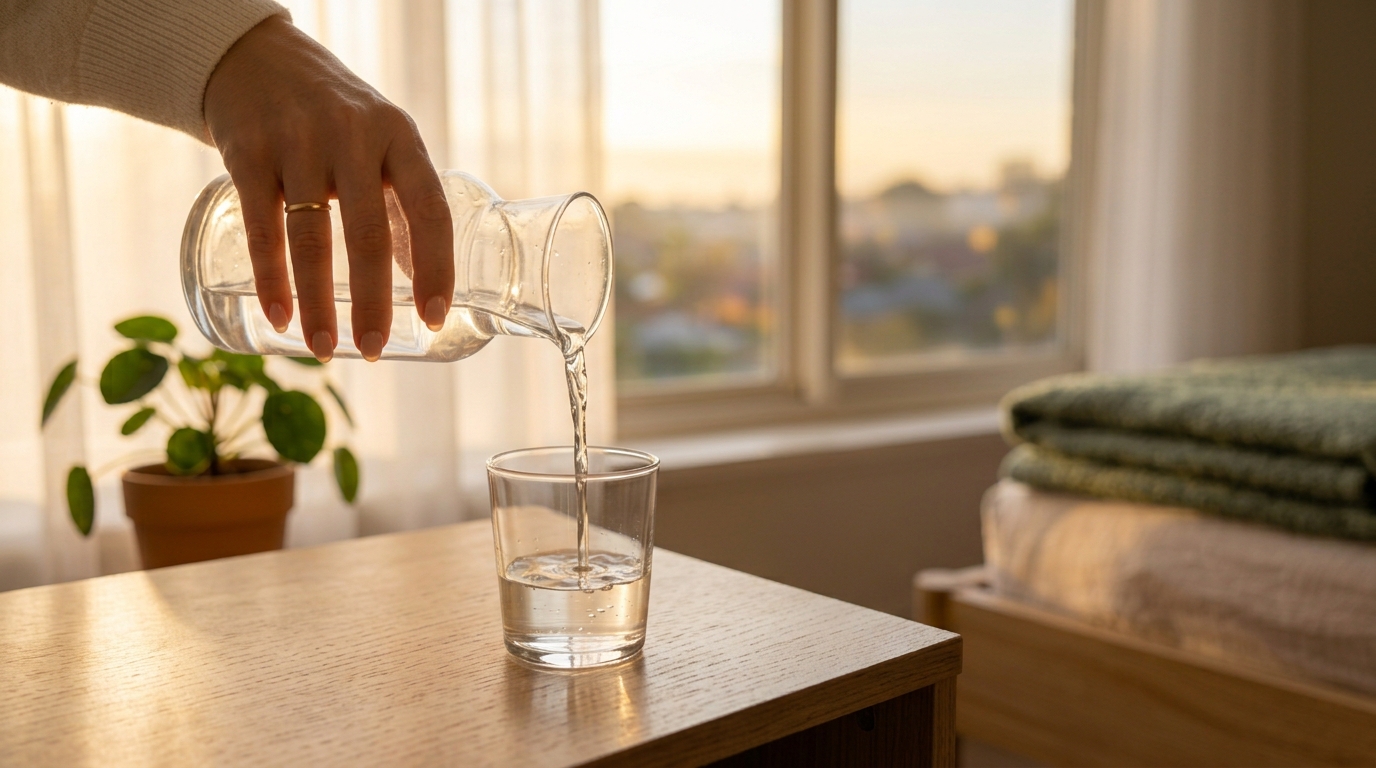
Most people already know they should drink more water. What’s less obvious is how often a restless, foggy, slightly irritable afternoon has nothing to do with the day itself and a lot to do with an empty glass. Mindful hydration is the practice of treating a glass of water as a small, regular moment of attention instead of something to squeeze in when you remember.
It costs nothing and takes about thirty seconds each time.
What Mild Dehydration Does to Mood
A study led by Lawrence Armstrong and colleagues at the University of Connecticut (2012), published in The Journal of Nutrition, tested what happens when healthy people become only slightly dehydrated. The paper, “Mild dehydration affects mood in healthy young women” (volume 142, pages 382–388), followed 25 young women with an average age of about 23. Each completed three eight-hour sessions: one in which dehydration was brought on by moderate exercise, one in which exercise was combined with a diuretic, and a control session in which they stayed well hydrated. Those who reached at least 1 percent dehydration lost about 1.36 percent of their body mass.
When the women were mildly dehydrated, their vigor dropped, fatigue and inertia rose, and overall mood worsened. They also reported that tasks felt harder, that it was harder to concentrate, and that they had more headaches. Most of their measured thinking performance, however, did not change. In other words, they felt worse before they clearly performed worse.
It was a small study of young, active women, and the dehydration was induced under lab conditions, so it doesn’t tell anyone how much water to drink. It does show something useful: a small shortfall can quietly color how a day feels.
A companion study from the same research group looked at men. In a 2011 paper in the British Journal of Nutrition (volume 106, pages 1535–1543), Matthew Ganio and colleagues studied 26 young men, average age 20, in three randomized trials with exercise on a treadmill in a warm room, with or without a diuretic. Dehydration averaged 1.59 percent of body mass, compared with essentially no change in the hydrated control trial. Here the thinking results were less reassuring: the dehydrated men made more errors on a visual vigilance task and were slower on a visual working-memory task, and they reported more fatigue and more tension and anxiety. The authors concluded that mild dehydration without overheating harmed vigilance and working memory in men.
Put side by side, the two studies tell a mixed story. Mood and fatigue were affected in both, while effects on thinking performance showed up in the men but mostly not in the women. Both used lab-induced dehydration with exercise, mostly in young adults, so they cannot say what happens to a sedentary office worker or an older adult who forgets to drink. What they support is modest: feeling a bit off at the end of a long, busy morning can have a very ordinary, fixable cause.
It’s worth saying plainly that the mind leads here, not the glass. Water doesn’t create calm. It just removes one source of static, so attention has less to fight through.
The Buddhist Source Behind This Practice
The Dhammapada, verse 80, is a one-line teaching about exactly this kind of everyday skill. In Acharya Buddharakkhita’s translation it reads: “Irrigators regulate the rivers; fletchers straighten the arrow shaft; carpenters shape the wood; the wise control themselves.” According to the traditional commentary, it was spoken about a young novice who watched farmers channeling water, arrow-makers straightening shafts, and carpenters bending wood, and realized that if people can master such things, he could master his own mind.
The image works well for hydration. Water goes where you direct it, and a habit goes where you channel it. A glass of water at a steady, chosen moment is a tiny act of irrigation: you decide where the flow goes instead of letting the day decide for you.
Two verses later, in verse 82, the Dhammapada compares a wise person who has heard the teaching to a deep lake, clear and still. A glass of water can be a small reminder of that image. Before you drink, you can look at the water, notice that it is clear, and let your own attention settle for the length of one breath. Nobody is asking you to become a lake. The image only offers a direction: a bit clearer, a bit stiller, than the moment before.

How to Practice Mindful Hydration
- Start with one glass after waking. Drink it slowly, before screens, and notice the temperature and the swallow.
- Pause at the first sip. One breath, one sip, and a moment of attention. That’s the whole practice.
- Tie it to something you already do. After a meeting, before a meal, or when you sit down at your desk. Habits stick to existing cues.
- Keep the bottle where you can see it. A bottle on the desk works as a quiet reminder without a phone alert.
- Notice thirst versus restlessness. Sometimes the urge to check your phone is really the urge for a pause. A glass of water can answer either one.
- Keep it light. Don’t turn it into another score to track. Steady and unremarkable beats perfect.
A Thirty-Second Water Pause
Here is the whole practice, start to finish. Pour or pick up the glass and look at it for a moment. Feel its weight and temperature in your hand. Take a slow breath, then a first sip, and let the water sit in your mouth before you swallow. Notice the swallow, the coolness traveling down, and whatever the body is doing: shoulders, jaw, belly. Take a few more sips at an unhurried pace. When the glass is empty or you are done, pause once more and notice whether anything has changed, even slightly. If nothing has, that is fine. You have still taken thirty seconds that were not spent on a screen.
Using Water as a Reset Between Tasks
One of the most useful places for a water pause is the gap between two tasks. Finishing a call, closing a document or coming home from an errand each leaves a bit of mental residue, and carrying it straight into the next thing is how a day starts to feel like one long blur. A glass of water gives that gap a shape. You stand up, walk to the tap or the kitchen, and for thirty seconds you have no other job than drinking. Then you return to work with a slightly clearer sense of where one thing ended and the next began.
It can also work as a gentle check-in. Before the first sip, ask yourself three plain questions: how is my body, how is my mood, and what do I need right now? Sometimes the answer is just water. Sometimes it is a short walk, a stretch, or a word with a friend. The point is not to diagnose yourself but to build the habit of asking, which is a small, practical form of the self-regulation the Dhammapada verse describes. If you try this for a week and it does nothing for you, drop it without guilt; the Kalama Sutta’s advice to test teachings against your own experience applies just as well to a glass of water as to a sutta.
Making the Habit Fit Your Life
If plain water bores you, add a slice of lemon or cucumber, or use warm water in cold weather. Tea and other drinks count as part of your day too, though they are a different practice, which we cover in the tea meditation guide. If you often forget to drink, anchor a glass to events that already happen reliably, such as brushing your teeth, starting the kettle or sitting down for lunch. If you are tracking something, track only the pauses, not the ounces. The purpose of this practice is attention, and counting can quietly turn it back into a chore.
People who have medical conditions, who take medicines that affect fluids, or who exercise heavily in the heat may need individual advice about how much to drink, and the right person for that is a doctor or dietitian. Nothing on this page is meant to replace that advice. It is also worth knowing that thirst is only one of many cues, and that on some days restlessness is just restlessness. The kind approach is to try the pause, notice what you find, and adjust.
None of this is medical advice. How much water you need depends on your body, your climate, and your health, and a doctor is the right person to ask about specific concerns. What mindful hydration offers is simpler: a few unhurried moments a day, each one a small choice to look after the body that carries your attention around.
For another everyday ritual built on the same idea, read Tea Meditation.
This article is part of the Learn library at Buddhism with Maitreya Dharma, where modern neuroscience and the Buddha’s teachings meet in practical, everyday language — no background in Buddhism required.