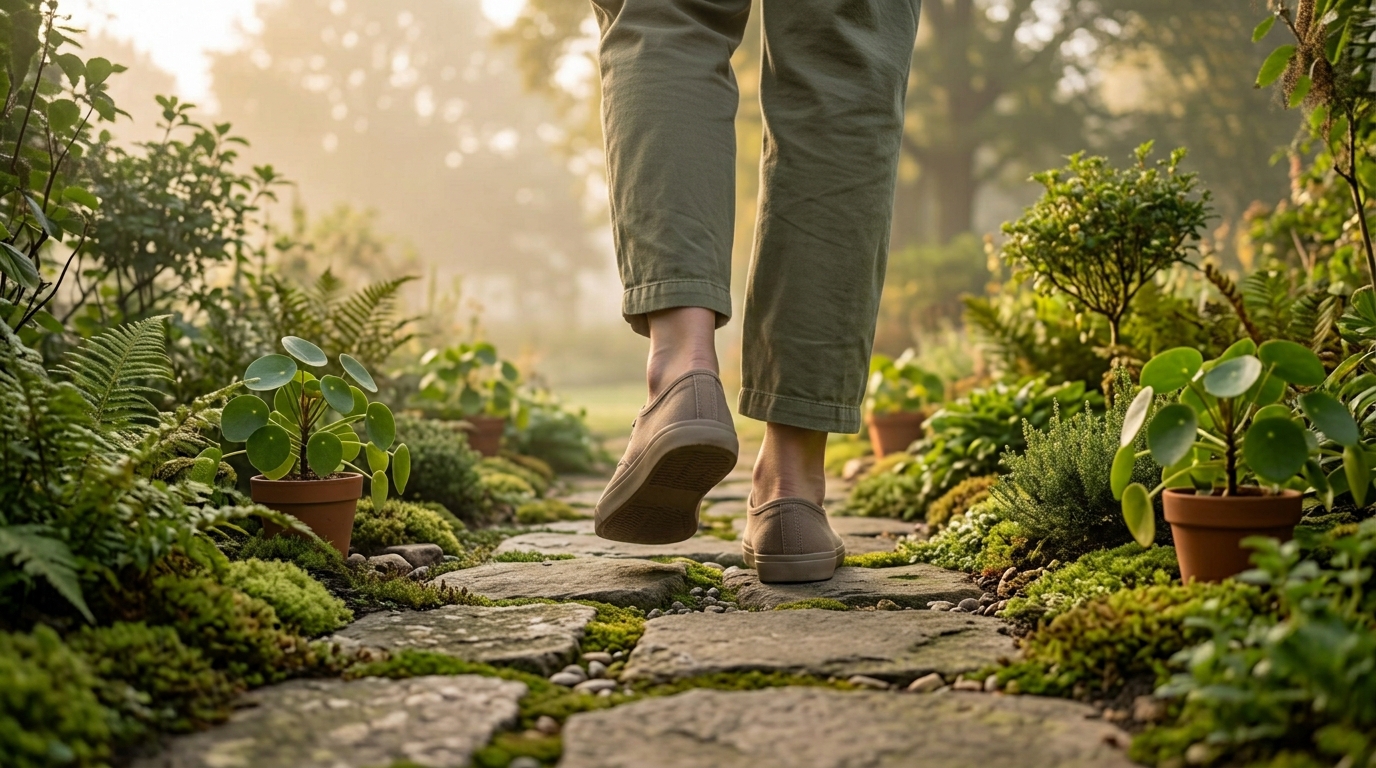
Walking is the one form of exercise almost everyone already does, usually while thinking about something else. Mindful walking asks for very little change: the same legs, the same path, but with attention placed on the walking itself. It is one of the oldest meditation practices there is, and one of the easiest to begin, because there is nothing to set up.
It works as a short practice between meetings, or as a slow lap around the block.
What Research Says About Walking and Thinking
Researchers Marily Oppezzo and Daniel Schwartz at Stanford University published a set of four experiments in 2014 in the Journal of Experimental Psychology: Learning, Memory, and Cognition, involving 176 people. They compared how participants performed creative thinking tasks while walking and while sitting.
On a test of divergent thinking, where people list alternative uses for everyday objects, walking increased creativity scores for 81 percent of participants, according to the paper’s abstract. On a convergent test, where you narrow down to one correct answer, the benefit was much smaller, with 23 percent improving. Press coverage of the work reported that walkers produced upward of 60 percent more creative responses than sitters in the first three experiments, but that figure is a headline summary, not a result we can verify from the abstract. In a fourth experiment, people sat indoors, walked on a treadmill indoors, walked outdoors, or were pushed in a wheelchair outdoors, and outdoor walking produced the most novel, highest-quality analogies. Those who sat down after walking kept some of the boost.
This study tested walking, not walking meditation, so it doesn’t prove that mindful walking has the same effect. It does give a concrete reason to treat a walk as more than a way of getting somewhere. The body in gentle motion seems to loosen the mind, and mindfulness can then make use of that looser state.
It is worth keeping the caveats in view. The 176 participants were mostly college students. Some researchers who were not involved have argued that listing uses for everyday objects does not reflect real-world creativity, and the lead author has said the study measured one kind of creative thinking, with the mechanism still unknown. So the study is best read as a friendly nudge to get up and walk, not as a promise about your next big idea.
A trial that did test mindful walking was published in 2013 by Michael Teut and colleagues in Evidence-Based Complementary and Alternative Medicine. It randomized 74 adults with moderate to high perceived stress, most of them women with an average age around 50. The 36 people in the intervention group took part in eight sessions over four weeks, each with 40 minutes of walking, 10 minutes of mindful walking, and 10 minutes of discussion, while the 38 in the control group simply waited. At four weeks, scores on Cohen’s Perceived Stress Scale had fallen by an adjusted 8.8 points in the walking group and 1.0 in the control group, a statistically significant difference, and the authors also reported better quality of life. Because the comparison group received nothing, we cannot tell how much came from mindful walking itself, how much from walking, group company, or expectation, and the authors themselves called for future trials with an active comparison group and long-term follow-up.
The Buddhist Source Behind This Practice
In the Satipatthana Sutta (Majjhima Nikaya 10), the Buddha’s central teaching on mindfulness, walking is named directly. A practitioner, when going, knows “I am going.” The sutta then goes on to apply clear comprehension to going forward and back, looking ahead and away, and the rest of ordinary movement.
There is no special technique hidden in that line, and that is the point. Mindfulness of walking is just knowing that you are walking while you are walking. The teaching treats movement as a place where awareness can live, not an obstacle to it.
Walking meditation also has a short discourse of its own. In the Cankama Sutta (Anguttara Nikaya 5.29), in Thanissaro Bhikkhu’s translation, the Buddha lists five benefits: the ability to travel on foot, tolerance for physical strain, protection from illness, better digestion, and concentration gained while walking that lasts for a long time. Some of that is plainly practical and some is a claim you can only test for yourself. We mention it as the tradition’s own account, not as medical advice.
How to Practice Mindful Walking
- Choose a short path. Ten or twenty steps in a hallway, a garden, or a quiet corner is enough. You can also use a normal outdoor walk.
- Start by standing still. Feel your feet on the ground and take one slow breath.
- Walk a little slower than usual. Let each step have a clear beginning, a middle, and an end: lift, move, place.
- Keep your attention on the feet. Notice the contact, the pressure, the shift of weight from one side to the other.
- Let the eyes rest. Look a few steps ahead, with a soft gaze, and let sights and sounds pass without following them.
- When the mind wanders, come back to the next step. That is the practice, not a failure of it.
- Turn at the end and begin again. Five minutes of this is plenty.
You can adapt the practice in a few ways. If very slow walking feels self-conscious, walk at your normal pace and keep your attention on the contact of your feet with the ground. If you like a little structure, quietly note “lifting, moving, placing” with each step and let the words fade as the sensations become clear. Choose level, safe ground, and hold a rail or wall if your balance is uncertain. If walking is difficult for you, the same attention can rest on any movement you can feel, such as the shift of weight in a seated stretch or the pressure of your hands on the wheels of a chair. The aim is not a particular speed, but knowing what the body is doing while it does it.
Mindful walking doesn’t ask you to get anywhere. If you only ever do it for five minutes a day, you have still added a small, steady practice to a day that probably needed one.
Mindful walking also fits into the cracks of an ordinary day. You might take the first minute of a walk to a meeting with your attention on your feet, or use the stretch between a parking spot and a front door as a short practice. Some people walk for a few minutes before sitting down to a task that needs fresh ideas, which is consistent with the Stanford findings, though that study did not test mindfulness. Others use a slow lap around the block at the end of the workday to mark the shift from work to home. Because the practice needs nothing but ground under your feet, the best time for it is usually the next time you notice you are already walking.
To pair walking with a quieter mind, read Silence Meditation, which uses the same idea of letting sounds come and go.
For a longer, slower version among trees, see our guide to forest bathing.
One more note on expectations. Neither study here shows that mindful walking will make you calmer or more inventive on any given day, and individual experience varies widely. A reasonable way to treat the research is as a low-cost experiment: try a short walk with attention on your feet for a couple of weeks, notice how your mood and focus feel afterward, and keep it only if it earns its place. That is also very much in the spirit of the Kalama Sutta, which invites you to test teachings against your own experience instead of accepting them on authority.
When Your Mind Wanders, or the Walk Feels Awkward
Almost everyone finds that attention drifts within a few steps. That is not a failure; noticing that you have drifted and coming back to the feet is the practice itself. The Satipatthana Sutta (Majjhima Nikaya 10) describes the same simple move: when walking, one understands “I am walking,” and the sutta treats that plain knowing as enough to build on. If you feel self-conscious, pick a quiet corridor, a back yard, or a park path where nobody is watching. If you feel dizzy or unsteady when you slow down, speed up and keep your eyes open and soft, looking a few meters ahead.
It also helps to start small. Two or three minutes is a real session. Many people find it easier to begin with a fixed path of ten to twenty steps, turning around at the end and noticing the turn as part of the walk. Over a week or two you can lengthen the time, or carry the same attention into walking you already do. There is no need to measure progress; the useful question each time is only whether you were, for a moment, aware that you were walking.
This article is part of the Learn library at Buddhism with Maitreya Dharma, where modern neuroscience and the Buddha’s teachings meet in practical, everyday language — no background in Buddhism required.