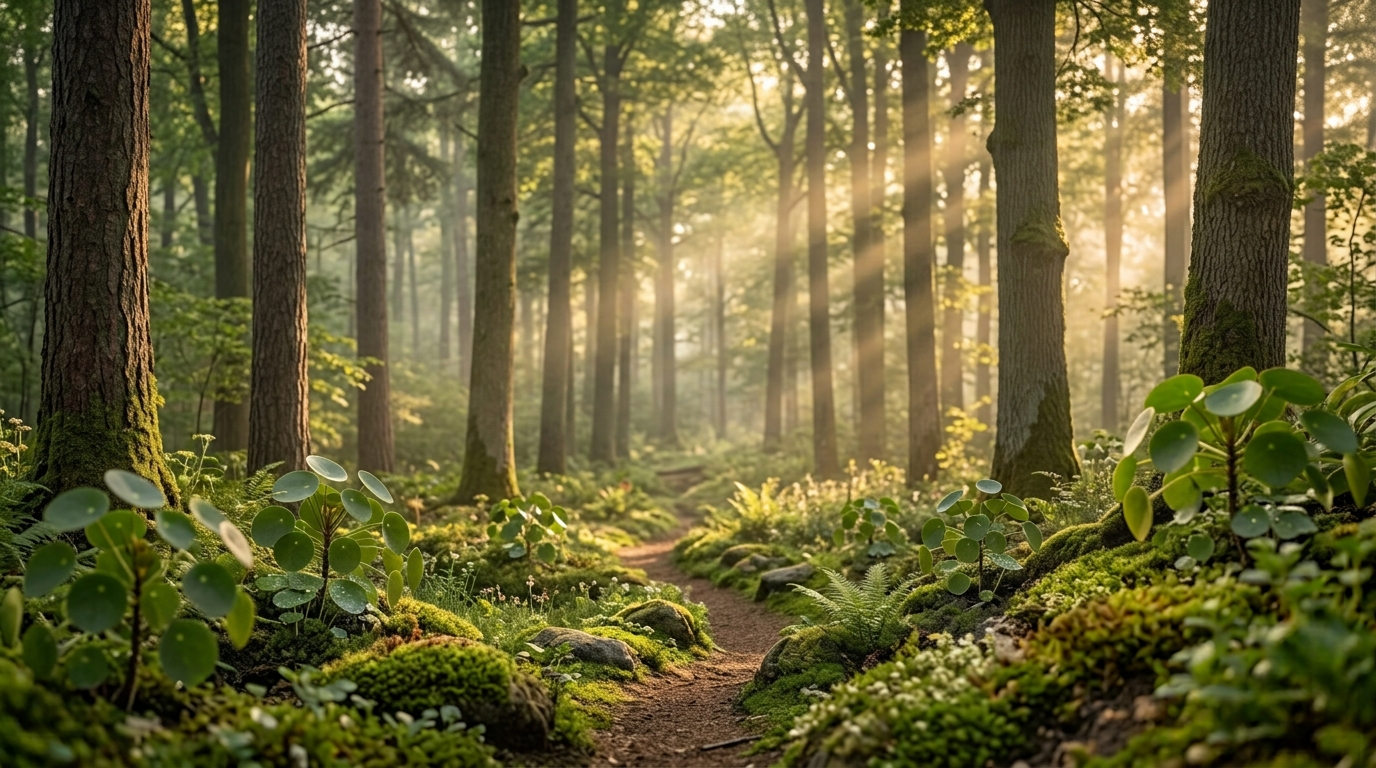
Forest bathing sounds like a wellness trend, but it is a plain idea with a Japanese name: shinrin-yoku, literally “taking in the forest atmosphere.” There is no swimming and no destination. You go into a wooded place, slow down, and let your senses do the work.
It is among the easiest forms of mindfulness to understand, because the forest keeps asking you to look, listen, and breathe.
What Research Says About Forest Bathing
A team led by Bum Jin Park, with Yuko Tsunetsugu, Tamami Kasetani, Takahide Kagawa, and Yoshifumi Miyazaki, published a field study in 2010 in the journal Environmental Health and Preventive Medicine. It involved 280 participants across 24 forests in Japan. Participants spent time in a forest area and in a city area, on separate days, and the researchers measured their bodies afterward.
The design was careful in a few ways. Each of the 24 forest sites hosted 12 participants, and the groups swapped places on the second day, so every person served as their own comparison. The walks lasted about 16 minutes and the viewing periods about 14, with measurements taken in the morning before breakfast, alcohol and tobacco prohibited, and caffeine controlled. Those details make the results more trustworthy, and they also show how short the exposure was: this was a quarter of an hour among trees, not a week-long retreat.
The forest results pointed toward relaxation on every measure. In the forest setting, salivary cortisol, a stress hormone, was about 13.4 percent lower after viewing the forest and 15.8 percent lower after walking in it. Pulse rate was about 6.0 percent lower after viewing and 3.9 percent lower after walking, and systolic and diastolic blood pressure were lower by roughly 2 percent. The authors summarize the overall pattern as lower cortisol, pulse rate, and blood pressure in forests than in city settings.
The researchers also looked at heart rate variability, a way of estimating the balance between the body’s calming and arousing nervous system activity. A measure linked to parasympathetic, or calming, activity was about 56 percent higher after viewing and 102 percent higher after walking, while a measure of sympathetic, or arousing, balance was about 18 and 19 percent lower. Put plainly, the body looked more settled.
The participants were young male university students in good health, and the visits were short, so the findings say little about older adults or long-term effects. Even so, a consistent drop across 24 different forests is a strong hint that the setting itself matters.
What Larger Reviews and Immune Studies Add
One field study cannot settle anything, so it helps to look at the wider picture. In 2017, Margaret Hansen, Rachel Jones, and Kirsten Tocchini published a state-of-the-art review of shinrin-yoku in the International Journal of Environmental Research and Public Health, culling 127 papers down to 64 for their summary. They reported that forest exposure was associated with lower blood pressure in several studies, lower salivary cortisol in several others, and better mood, with people under chronic stress showing some of the largest reductions in hostility, depression, and anxiety. They were also frank about the limits: many studies were small, drew on students, used short exposures, or skewed toward men, and the authors called for more long-term research, especially outside Japan.
A separate line of research looks at the immune system. In 2010, Dr. Qing Li of Nippon Medical School in Tokyo reported in Environmental Health and Preventive Medicine that adults who took a three-day, two-night forest trip showed significantly higher natural killer cell activity and more natural killer cells than on a normal working day, along with lower urinary adrenaline. The author reported that the higher activity lasted more than 30 days after the trip, and that a city tourism visit did not produce the same rise. These are laboratory markers, and the published abstract does not give sample sizes or discuss limitations, so they are better read as an interesting signal than as proof that forest bathing makes anyone healthier. Nothing here suggests that a walk replaces medical care.
Taken together, the direction is consistent: calmer body measures, better mood, and some hints of immune effects. But most of the evidence is short-term, small, and drawn from particular groups. That is a good reason to treat forest bathing as a low-cost, low-risk practice worth trying, not as a treatment.
The Buddhist Source Behind This Practice
The Dhammapada, verses 98 and 99, speak about exactly this. Verse 98 says, in Acharya Buddharakkhita’s translation, that inspiring is the place where the awakened dwell, whether in a village, a forest, a vale, or on a hill. Verse 99 adds that the forests are inspiring because those who are free of craving find joy there, where others find none.
Buddhist tradition places many key moments of the Buddha’s life among trees, and forest dwelling has long been a monastic ideal. The teaching isn’t that forests are magic. It is that a quiet place with few demands gives the mind room to settle, and a settled mind finds the place beautiful.
The Buddha’s meditation instructions often begin with a place. In the Anapanasati Sutta (Majjhima Nikaya 118), in Thanissaro Bhikkhu’s translation, a monk goes to a forest, the shade of a tree, or an empty building, sits with the upper body straight, and breathes in and out with mindfulness. The forest here is not decoration. It is a working place for attention, chosen because it asks little of us and offers a steady stream of things to notice.
How to Practice Forest Bathing
- Choose any green place. A forest is ideal, but a large park with old trees can serve the same purpose.
- Leave the phone in your bag. Silence or airplane mode lets the place be the focus.
- Walk slowly, with no goal. You are not trying to cover distance. Stop whenever something catches your attention.
- Use all five senses. Notice the smell of earth, the sound of leaves, the feel of bark, the light moving through branches.
- Sit for ten minutes. Find a spot, settle, and let the sounds of the place come and go.
- Take a bottle of water. Unhurried time outdoors is easier when you’re comfortable.
A few practical details make the walk easier. Allow about an hour, and give the first ten minutes to arriving: let your pace drop and your shoulders fall. Then take your attention through the senses one at a time, spending a minute or two on sound, then smell, then touch, then sight. When the mind drifts to a to-do list, which it will, simply return to whatever you were noticing. Wear shoes that suit the ground, stay on marked paths, check the weather, and let someone know where you are going if the trail is remote. If you cannot reach a forest, a park with mature trees is a reasonable substitute, and if walking is difficult, sitting at the edge of green space still counts. The point is slowness and attention, not distance.
It also helps to be clear about what forest bathing is not. It is not a workout, a hike with a target, or a photography trip, although you may enjoy all three at other times. In the field study, the participants walked for about a quarter of an hour at an easy pace, and the measured effects appeared anyway. If you find yourself checking a fitness tracker or racing the light, slow down and begin again. Many people find it useful to end the visit by sitting for a few minutes and writing two or three lines about what they noticed, such as a sound they had not heard before or the way the air changed under the trees. Those few lines are a small way of bringing the walk home with you, and of seeing, over weeks, which parts of it you return to.
You don’t need a famous forest or a free weekend. One hour among trees, taken slowly, may be one of the cheapest ways to give the body a break from the noise of ordinary days.
If you try it, give it a fair test. Choose the same kind of place once a week for a month, notice how you feel when you arrive and again when you leave, and let your own experience, rather than any single study, be the judge. Some visits will feel quiet and spacious, others restless, and both are useful information about where your attention tends to go.
For a quieter way to bring the same stillness indoors, see Silence Meditation.
If you would like to carry the same attention into everyday movement, our guide to mindful walking is a good next step.
This article is part of the Learn library at Buddhism with Maitreya Dharma, where modern neuroscience and the Buddha’s teachings meet in practical, everyday language — no background in Buddhism required.