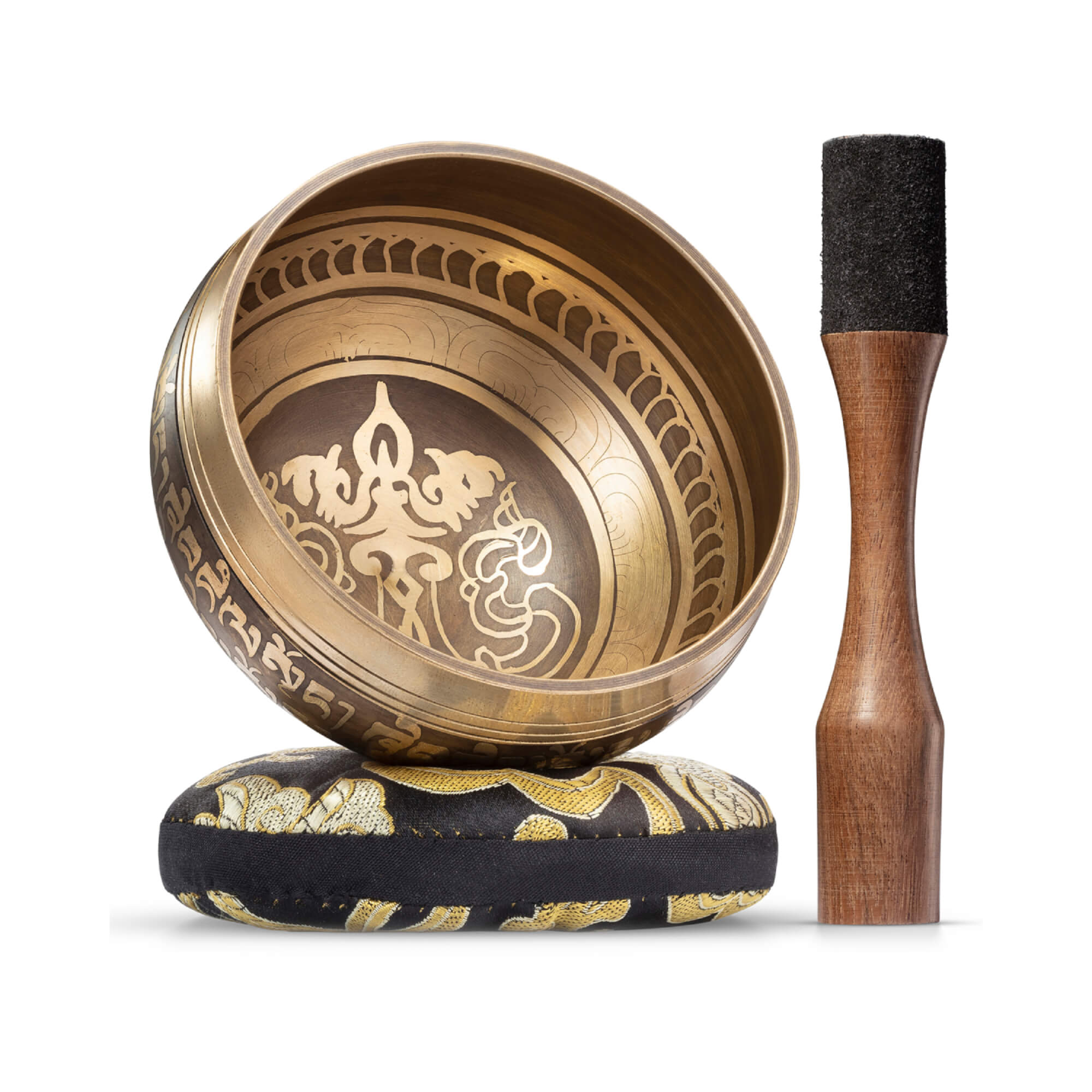
Why does a single bowl tone make your shoulders drop before your mind even catches up? It is not a metaphor. There is an actual nerve running from your ear canal down through your chest and gut, and certain sounds switch it on directly.

A moment of quiet listening.
The Nerve That Runs From Your Ear to Your Gut
The vagus nerve is the longest cranial nerve in the body, wandering from the brainstem down through the throat, lungs, heart, and digestive tract. It is the main highway of the parasympathetic nervous system — the “rest and digest” side that slows the heart, deepens the breath, and settles digestion once a stressful moment has passed.
Most of the vagus nerve sits deep inside the body, out of reach. But one small branch, the auricular branch, surfaces at the ear — specifically the concha and the ear canal wall. This is the only place the vagus nerve is close enough to the surface to be reached by sound waves and touch. When a low, sustained tone vibrates against that spot, it is not just “relaxing” in a vague sense. It is direct mechanical input to a nerve that governs how calm your whole body feels.
What a 20-Minute Bowl Session Actually Does to Your Heart
A 2026 study from Politecnico di Milano and the IRCCS Istituto Auxologico Italiano, presented at the International Conference on e-Health and Bioengineering, put this to a direct physiological test. Researchers Sarah Solbiati and colleagues monitored 20 healthy adults with electrocardiography and seismocardiography during a 20-minute Himalayan singing bowl session.
The results showed measurable changes in cardiac electro-mechanical activity: longer RR intervals (the time between heartbeats, a marker of a slower, more regulated heart rate), longer QT intervals, lower systolic blood pressure, and enhanced parasympathetic modulation — the vagus nerve visibly doing its job. Interestingly, female participants showed greater sensitivity to the effect, though the overall pattern held across the group.
This is a different kind of evidence than a mood survey. It is the nervous system itself, measured beat by beat, shifting into a calmer state while the sound is still playing.
The Buddha’s Teaching on Sound, 2,500 Years Early
Long before anyone could measure heart rate variability, the Buddha gave a teaching about exactly this kind of raw sensory moment. In the Bahiya Sutta (Udana 1.10), he instructed a man named Bahiya who was desperate for a quick, direct path to peace: “In the seen, there will be just the seen; in the heard, just the heard.” No story added, no judgment attached — just the sound itself, arising and fading.
That instruction describes almost exactly what happens in a well-run sound practice. You are not trying to relax. You are not analyzing the tone. You are simply letting the hearing be hearing, and the nervous system responds on its own terms. The teaching and the physiology are pointing at the same door from two different centuries.
How to Get the Most Out of This Practice
- Let the tone fade all the way out before starting again. The silence after the sound is doing as much work as the sound itself — it gives the nervous system a moment to register the shift.
- Sit with the sound instead of the story about it. If you notice your mind labeling the experience (“this is working” or “I don’t feel anything yet”), gently return attention to the raw sound.
- Ten minutes is enough to start. The study above used 20 minutes, but even a short session gives the auricular branch real input to work with.
- Notice the small signs of a shift — a spontaneous deep breath, a swallow, a slight loosening in the jaw or shoulders. These are the vagus nerve’s own signal that something has changed.
This is not a technique reserved for hard days. A nervous system that gets regular, direct signals of safety through sound tends to recover faster from ordinary stress too — which is really the whole point of practicing at all.
For the science behind sound baths more broadly, including how they affect mood and tension, see Meditation and Sound: What Sound Bath Science Actually Shows.
This guided meditation and article are part of the Learn library at Buddhism with Maitreya Dharma, where modern neuroscience and the Buddha’s teachings meet in practical, everyday language — no background in Buddhism required.