
Photo by Sandy Millar on Unsplash
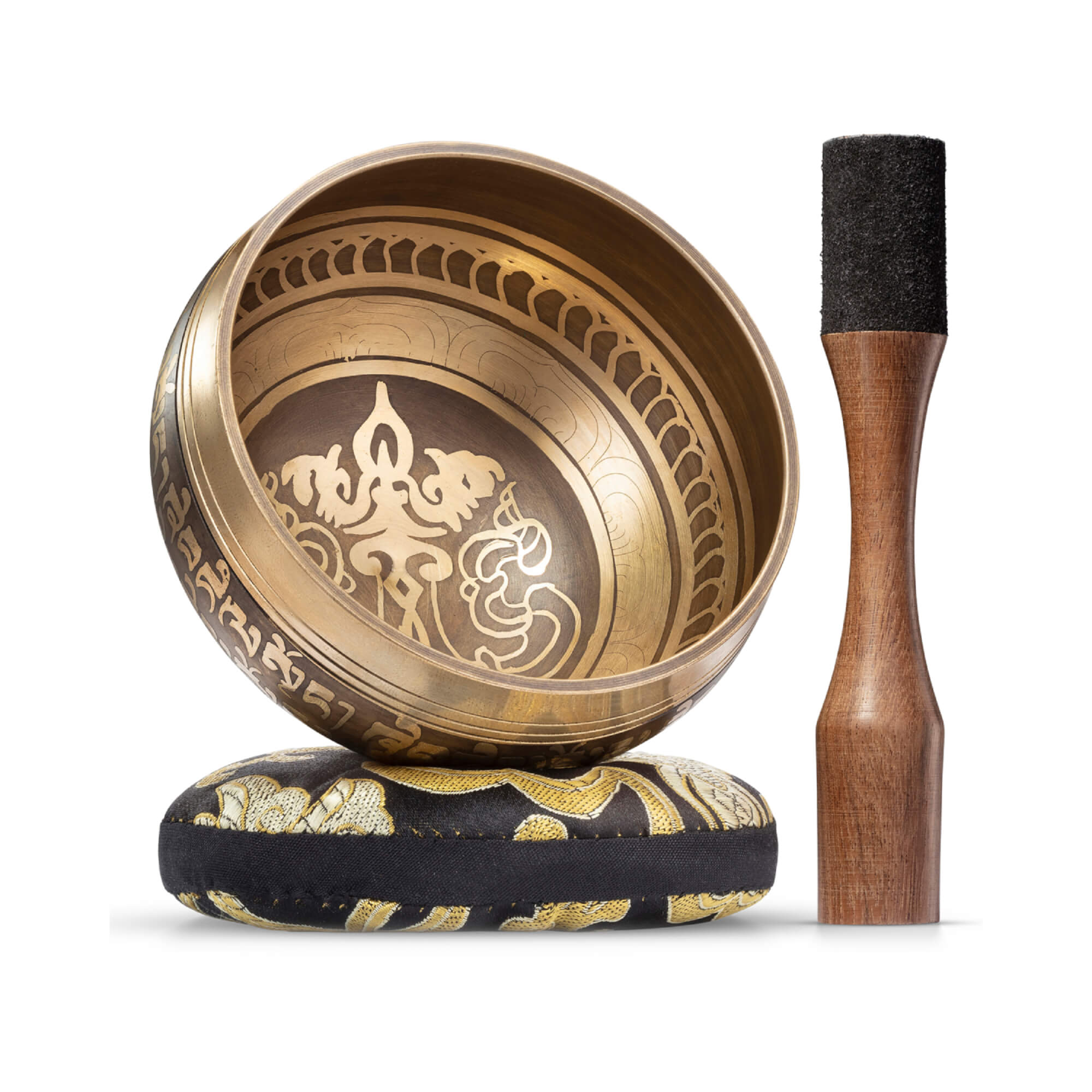
You’ve probably seen it all over your feed lately — sound baths, singing bowl sessions, “sonic meditation.” It can look like a trend. But sit through one, even for five minutes, and something real happens: the mind stops chasing its own noise and starts following a single, simple sound instead.
That’s not an accident, and it’s not new. Long before “sound bath” was a search term, meditators were already working with exactly this — what happens in the mind the instant a sound arrives, rings, and fades. Here’s what the neuroscience says about why it works, and what a much older source has to say about how to actually practice it.
Why a Single Sound Can Quiet a Busy Mind
A sound like a singing bowl gives the mind something narrow to hold onto. Instead of following a thought from one worry to the next, attention has one job: track the tone as it rises, sustains, and slowly dissolves into silence. That’s a much easier target for a distracted mind than “just relax” ever is.
This isn’t only a subjective impression. Researchers Tamara Goldsby, Michael Goldsby, Matthew McWalters, and Paul Mills at the University of California, San Diego published an observational study in the Journal of Evidence-Based Integrative Medicine (2017) measuring mood before and after a Tibetan singing bowl meditation session. Participants reported significant drops in tension, anger, fatigue, and depressed mood, along with an increase in their sense of spiritual well-being. It’s a self-report study, not a controlled trial, so it can’t prove causation on its own — but it’s a consistent, specific finding, not a vague “sound is calming” claim.
A more physiological look came from Nike Walter and Thilo Hinterberger at University Hospital Regensburg, Germany, who recorded EEG, heart activity, and breathing in 34 participants before, during, and after a singing bowl session (Medicina, 2022). Their recordings picked up measurable shifts in brain activity and heart rhythm during the session — the kind of pattern associated with a body settling out of alert, effortful attention and into a more restful state. It’s early-stage evidence and the sample was small, so it’s best read as “sound meditation is worth taking seriously as a physiological event,” not as a settled, sweeping claim.
The Part That’s Easy to Miss: It’s Not About the Bowl
Here’s where most “sound healing” content stops short. It’s tempting to frame the bowl itself as the mechanism — as if a particular metal alloy or frequency is doing something mystical to your nervous system. But the more useful way to understand it is simpler: sound gives you a clean, repeatable object to practice noticing your own reactions to.
A bowl rings. There’s a pull toward it — pleasant, magnetic, easy to like. A moment later it fades into silence, and there’s a small pull the other way — wanting it back, or noticing the mind get restless in the quiet. Neither reaction is a flaw. It’s just what attention does when something arises and passes. The practice isn’t forcing yourself to feel calm about the sound. It’s watching what the mind does with it, without getting pulled along.

Photo by Magic Bowls on Unsplash
The Buddhist Source Behind This Practice
This exact process — what happens in the mind between a sound arising and a sound fading — is the subject of a specific teaching from the Buddha: the Indriyabhāvanā Sutta, or the Sutta on the Development of the Faculties, Majjhima Nikaya 152.
In it, the Buddha describes what happens each time a sense faculty meets its object — including, specifically, when the ear meets a sound. Something agreeable arises, or something disagreeable, or a mixture of both. Most people either chase the agreeable reaction or push away the disagreeable one. The Buddha’s instruction was different: notice that the reaction has arisen, recognize it as something constructed and temporary, and let it settle into equanimity — the way a few drops of water land on a sun-heated iron plate and vanish almost as soon as they touch it.
That’s a strikingly precise description of what actually happens during a few minutes with a singing bowl. The tone strikes and there’s a pull toward it. It fades and there’s a pull the other way. The practice, according to this teaching, was never to eliminate that pull — it’s to notice it arise, and let it pass as quickly and completely as those drops on the hot plate. A bowl doesn’t manufacture that skill. It just gives you an unusually clear, repeatable place to practice it.
How to Get the Most Out of Sound-Based Meditation
- Let the silence do half the work. The gap after a tone fades is not dead space — it’s often where the mind’s reaction (wanting more, or getting restless) shows up most clearly. Stay with the silence instead of rushing to the next sound.
- Notice the pull, don’t fight it. If a tone feels soothing and you don’t want it to end, that’s useful information, not a problem to fix. Just notice “wanting this to continue” as it happens.
- Start with 5 minutes. A short, repeatable sound-based sit is easier to return to daily than a long session you dread finding time for.
- Use it as a transition tool. A minute of sound between “work mode” and “rest mode” — before a meal, before sleep, before sitting down to meditate — gives your attention a clear line to cross.
- Keep it consistent. The same sound, used the same way, becomes a cue your body starts to recognize and settle into faster over time.
None of this requires believing anything mystical about metal or frequency. What it asks is much simpler and, honestly, harder: sit with a sound long enough to actually watch what your mind does with it. That’s the whole practice — today, and 2,500 years ago.
Sound isn’t the only sense doorway worth working with this way — the same teaching applies to a breath, a physical sensation, or an emotion that arises and fades. If you’d like to go deeper into how sound specifically interacts with the body’s calming systems, the Vagus Nerve Reset article looks at how sound and breath both tap into the same calming pathway.
This article is part of the Learn library at Buddhism with Maitreya Dharma, where modern neuroscience and the Buddha’s teachings meet in practical, everyday language — no background in Buddhism required.