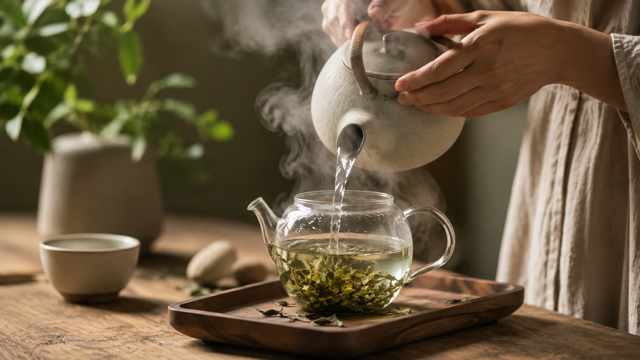
Most people already have a small pocket of quiet built into their day and don’t notice it — the few minutes it takes to make a cup of tea. That time usually gets treated as dead time, something to fill with a phone screen or a mental to-do list while the water heats. Tea meditation is simply the practice of reclaiming those minutes on purpose — treating the brewing and drinking of tea itself as the meditation, not the pause before one.
It requires no cushion, no special posture, and no extra time carved out of an already full day. The ritual you’re probably already doing becomes the practice.
Why an Ordinary Ritual Works as Well as a Formal Sit
A brief study by Nishikori, Taruoka, Kajita, et al. (2026), published in Cureus, offered a simplified 20-minute Japanese tea ceremony to ten palliative care staff — a group with well-documented, chronic occupational stress. Using the State-Trait Anxiety Inventory before and after the session, researchers observed a meaningful drop in both state anxiety (in-the-moment anxiety) and trait anxiety (general anxiety tendency) following the ceremony. Participants described the experience as immersive, sensorially calming, and a genuine break from the day — even though the study’s own authors were careful to note that this small, uncontrolled study can’t yet prove the tea ceremony itself, rather than simply the rest and attention it provided, caused the improvement. Larger controlled trials are still needed to say more.
That honest caveat is actually useful here. It points to what’s really doing the work: not the tea as a substance, but the structure of full, unhurried attention that brewing and drinking it requires. Heating water, choosing a cup, watching color and steam, waiting — these are small, repeated acts of single-pointed attention, the same basic mechanism behind any seated practice, just carried inside an activity you were going to do anyway.
The Buddhist Source Behind This Practice
The Buddha’s instructions on mindfulness weren’t limited to seated meditation. In the Satipatthana Sutta (“The Foundations of Mindfulness”), Majjhima Nikaya 10, he describes a quality called clear comprehension — being fully present and deliberate not just in formal practice, but in the ordinary motions of daily life: walking, bending, dressing, and specifically “eating, drinking, chewing, and savoring.” Drinking itself is named directly as a place where this quality of attention belongs.
This framing matters because it removes the idea that mindfulness only “counts” during a dedicated sit. The Satipatthana Sutta treats the whole of ordinary life — including something as small as a cup of tea — as valid ground for practice. Tea meditation isn’t a modern shortcut around real practice; it’s a direct, literal application of what this teaching already describes.
How to Get the Most Out of This Practice
- Heat the water slowly and watch it. Skip the instant setting if your kettle has one. The few extra minutes of attending to temperature and steam are the practice, not a delay before it.
- Choose one tea and stay with it. Switching teas or flavors to “optimize” the moment pulls attention toward evaluation instead of presence. Let the same cup be enough.
- Hold the cup before drinking. Notice its warmth in your hands for a breath or two before the first sip — a simple, physical anchor into the present moment.
- Drink without a screen. Even one daily cup taken in full attention re-trains the mind that not every quiet moment needs to be filled with input.
- Let the ritual end cleanly. Notice the last sip as the last sip, rather than drifting straight into the next task mid-cup. A clear ending is part of what makes the practice a practice.
Tea meditation doesn’t ask for a special occasion. It asks you to notice a pocket of time you already have and give it your full attention instead of letting it pass on autopilot. Some days that might be the only formal practice you get to — and per the Satipatthana Sutta’s own framing, that’s enough.
This article is part of the Learn library at Buddhism with Maitreya Dharma, where modern neuroscience and the Buddha’s teachings meet in practical, everyday language — no background in Buddhism required.